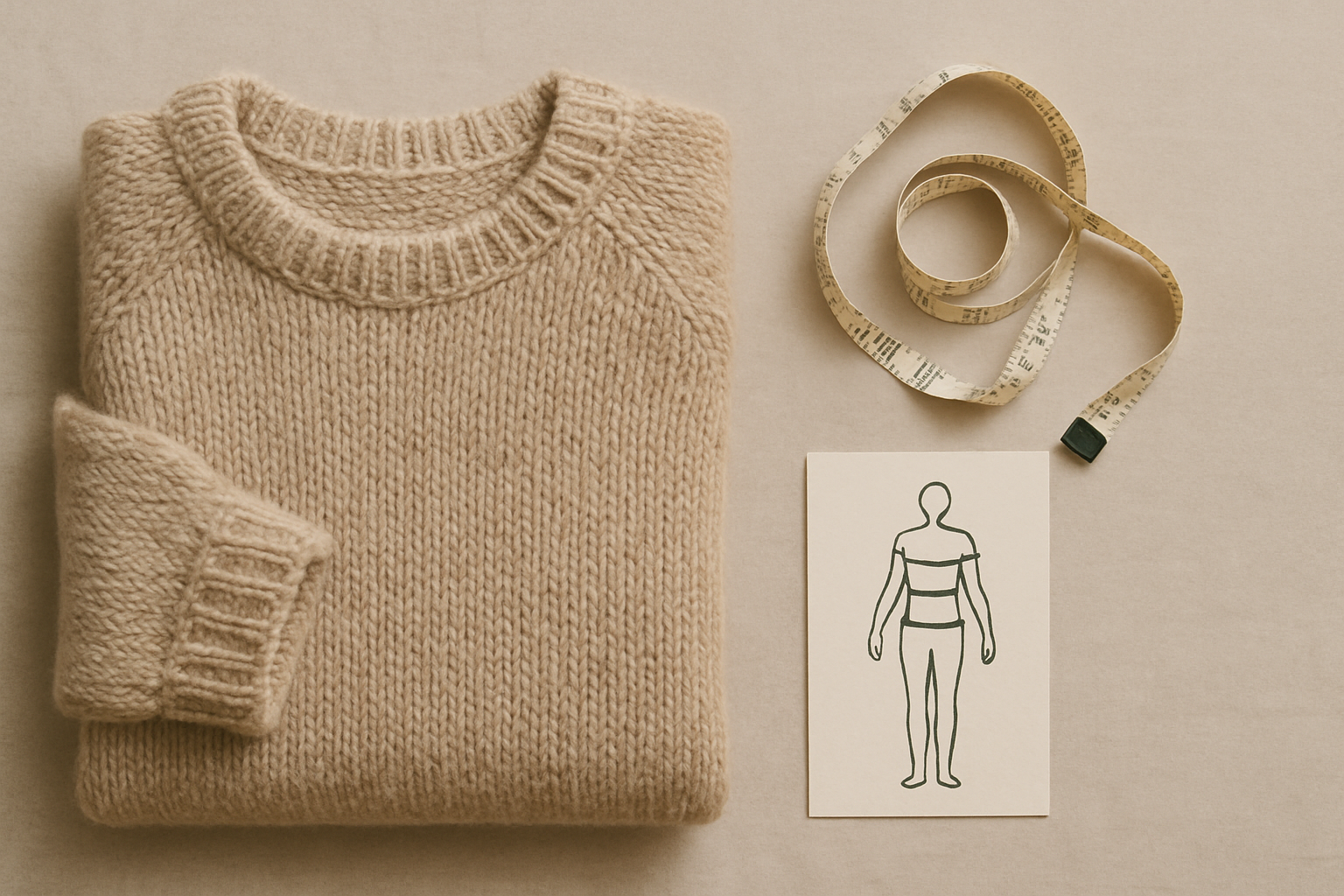
Ease and sizing basics
Ease is the finished garment measurement minus your body measurement, almost always taken at the chest. That one number decides whether a sweater hugs, skims, or drapes, and it is the reason your body chest and the pattern size are not the same figure.
Once you can see ease clearly, sizing stops being guesswork. You pick the fit you want, turn it into a finished chest, and match that to a size. Let's break down the three kinds of ease, the ranges to aim for, and the one step that knitters skip most often.
The three kinds of ease
Ease is just a comparison between two numbers: how big the garment is and how big you are.
Positive ease
The garment is bigger than your body. This is relaxed, roomy, or oversized depending on how much. Most everyday sweaters live here. The more positive ease, the more the fabric drapes away from you.
Zero ease
The finished garment matches your body measurement. It sits close without squeezing. A lot of classic fitted designs are written for zero ease at the chest.
Negative ease
The garment is smaller than your body and stretches to fit. It reads as fitted or clingy. You see it most in ribbed pieces, fitted tees, and stranded colourwork, where a snug, springy fabric holds its shape against the body.
Ease ranges to aim for
These are working ranges at the chest. Treat them as starting points, then adjust for the yarn, the stitch pattern, and how you like to wear things.
- Very fitted: about minus 5 to 0 cm (minus 2 to 0 in). Close to the body, often ribbed or knit in a stretchy fabric.
- Classic or standard: about plus 5 to 10 cm (plus 2 to 4 in). The reliable everyday sweater fit.
- Relaxed: about plus 10 to 15 cm. Roomy with some drape, good over a layer.
- Oversized: about plus 15 cm and up (plus 6 in and up). Loose, slouchy, deliberately big.
The Craft Yarn Council publishes standard body measurements by size along with fit and ease guidance, defining close-fitting, standard, and oversized garments by how much ease they add to the body. Those tables are what most published patterns size against, so they are a solid reference when a pattern leaves ease unstated.
Source: Craft Yarn Council, Standard Body Measurements and Fit guidance, craftyarncouncil.comHow to pick your size
Here is the step knitters miss. You do not match the pattern to your body chest. You match it to your body chest plus the ease you want.
Measure your actual chest or bust at the fullest point, snug but not tight. Decide the fit you're after and pick an ease figure from the ranges above. Add the two together: that total is your target finished chest. Now look at the pattern's schematic, find the size whose finished chest is closest to your target, and knit that size.
An example. Say your bust measures 96 cm and you want a classic fit with about 8 cm of positive ease. Your target finished chest is 104 cm. You scan the schematic and choose the size that finishes nearest 104 cm, even if its label or its listed body measurement reads as a different size. The finished number is the one that fits.
Where length and other points fit in
Chest ease gets the headlines, but the same idea applies elsewhere. Upper arm ease keeps a sleeve from binding. Hip ease decides whether a longer sweater skims or clings. Most patterns give a full schematic so you can check each finished measurement against your body plus the ease you want there. The chest is just the one that drives the size choice.
Let the tools handle the math
Once you know your target finished chest, the counts are arithmetic. The free pattern grading generator works from finished measurements, which already include your ease, and grades the whole garment across sizes with even shaping. So you decide the ease, add it to your body, and feed the grader the finished chest you want. For a single quick number, like a cast-on, the free knitting calculator turns gauge and a target width into stitches.
Your finished measurements are only as honest as your gauge, so read how to measure knitting gauge and steer clear of the usual gauge swatch mistakes. When you're ready to build the size range yourself, how to grade a knitting pattern walks through it step by step.
Sources
- Craft Yarn Council, Standard Body Measurements and Fit guidance, craftyarncouncil.com.
- Ann Budd, The Knitter's Handy Book of Patterns (Interweave) on finished measurements and sizing.
- Ysolda Teague, Little Red in the City, on choosing ease and fitting a knit to your shape.
- TECHknitting, on how knit fabric stretches and behaves with negative ease, techknitting.blogspot.com.
Frequently asked questions
What is ease in knitting?
Ease is the finished garment measurement minus your body measurement at the same spot, usually the chest. Positive ease means the garment is bigger than you. Negative ease means it is smaller and stretches to fit. Zero ease means they match.
How do I choose my size from ease?
Add the ease you want to your body chest, then find the pattern size whose finished chest is closest to that total. You match to the finished chest, not your body chest. So a 96 cm bust wanting 8 cm of ease looks for a finished chest near 104 cm.
What is negative ease and when do I use it?
Negative ease is a garment knit smaller than the body, so the fabric stretches to fit. It is common in ribbed pieces, fitted tees, and stranded colourwork, where a snug fabric holds its shape. Ranges of about minus 5 to 0 cm are typical for a close fit.
How much ease for an oversized sweater?
Roughly 15 cm (6 in) of positive ease and up at the chest gives the loose, drapey look. Classic everyday sweaters sit around 5 to 10 cm (2 to 4 in). Very fitted is minus 5 to 0 cm. Pick by the look you want, then check the schematic.
Does the pattern grader add ease for me?
No, and it should not. The grader works from finished measurements, which already include whatever ease you chose. You decide the ease, add it to your body, and feed the grader the finished chest you want it to build.