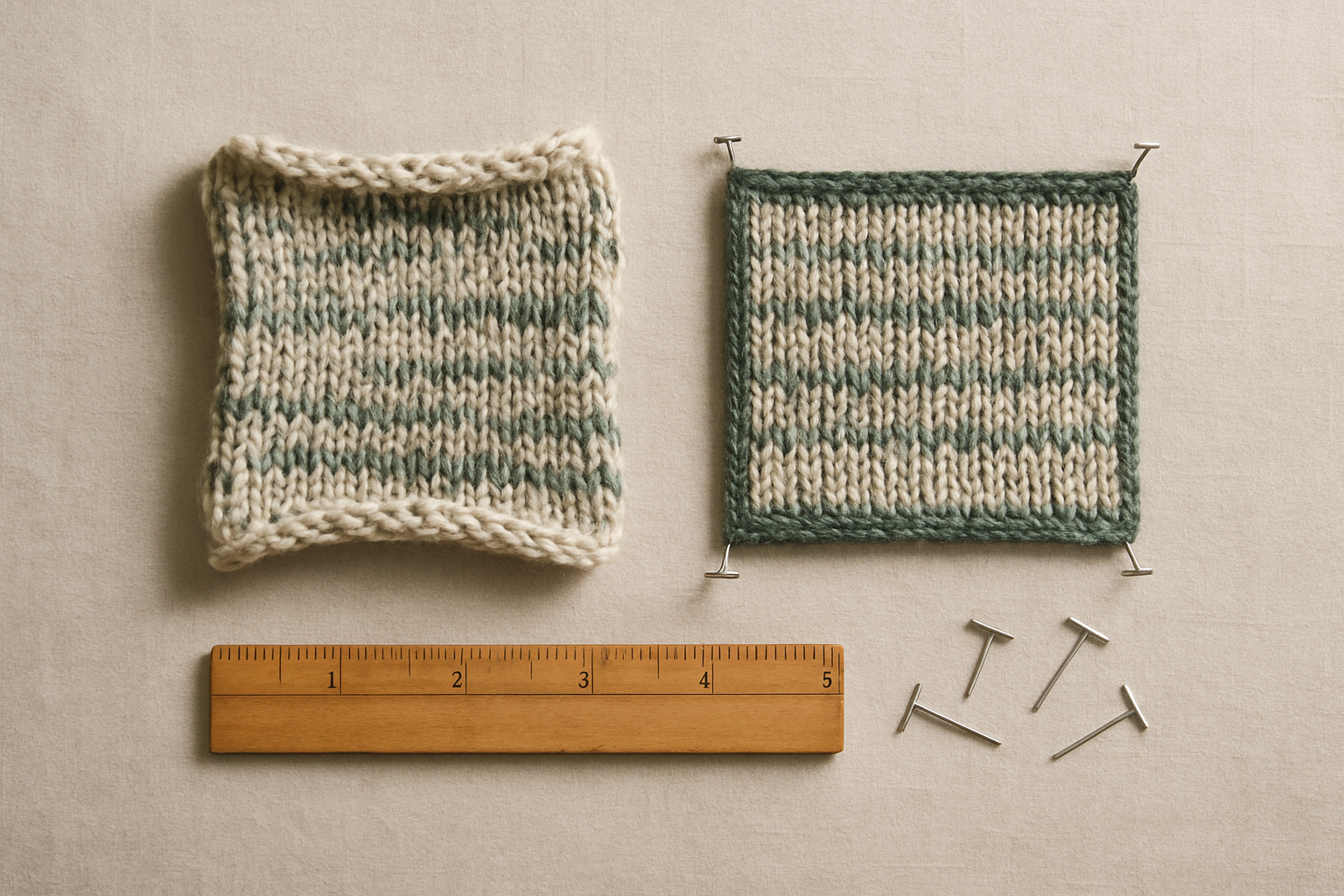
Gauge swatch mistakes that ruin the fit
The fix for almost every fit problem is a better swatch. The mistakes that ruin gauge are nearly all the same handful: a swatch that is too small, never blocked, or measured at the wrong spot. Get those right and the number you measure is the number you will knit.
Gauge is just stitches and rows over a set width, usually 10 cm or 4 in, worked in your pattern stitch and measured after blocking. When that number is off by even a little, the error gets multiplied across hundreds of stitches. So a sloppy swatch isn't a small sin. It's the thing that decides whether the sweater fits. Here are the mistakes, with the fix for each.
1. The swatch is too small
A tiny swatch is the most common mistake, and it sets up every other one. The edges of a knit curl and the stitches there sit unevenly, so if the swatch is only as wide as your ruler, you have nothing flat to measure. Knit at least 15 cm (6 in) square. That gives you a calm patch in the middle, away from the edges, where the stitches are honest. Bigger costs a bit more yarn and time, and it pays for itself the first time it stops you frogging a finished piece.
2. Measuring before blocking
If you'll wash and block the finished garment, you have to wash and block the swatch too. Wool especially relaxes and grows once it's wet and dried. Superwash wool and cotton can shift even more. An unblocked swatch reads tighter than the real fabric, so you cast on too many stitches and the sweater comes out big. Treat the swatch exactly the way you'll treat the sweater: same wash, same drying, then measure when it's dry.
The Craft Yarn Council's standard is to count stitches and rows over a 4 in (10 cm) square, measured on a blocked swatch. That 10 cm window is the reference every published gauge is built on, so measuring over a shorter span or an unblocked piece won't match the pattern.
Source: Craft Yarn Council, Standards and Guidelines, craftyarncouncil.com3. Measuring at the edge instead of the middle
Stockinette curls at the cast-on, the bind-off, and both side edges. Those rows and columns are stretched or bunched and they read a different gauge than the body of the fabric. Lay the swatch flat, pin or hold the curl down if you must, and place your ruler well inside the edges. You want the count from the calm centre, not the busy border.
4. Measuring over too short a span
Counting the stitches in 2 cm and multiplying by five looks quick, but it bakes in error. One miscounted stitch in a short span turns into five over the chest. Measure over the full 10 cm (4 in), and more if the swatch allows: count over 15 cm, then divide. The longer the span you average across, the smaller each stitch's share of the error, and the closer your number lands to the truth.
5. Ignoring row gauge
Stitch gauge sets the width, so it gets all the attention. Row gauge sets the height, and it decides where shaping lands. A yoke depth, a sleeve cap, an armhole, the spacing of waist decreases: all of those are counted in rows. If your row gauge is off, the chest can be perfect while the armhole finishes too shallow or too deep. Count rows over the same 10 cm and write the number down. Our tools keep row gauge in the math instead of dropping it.
6. Swatching in the wrong stitch pattern
Cables, ribbing, lace, and stranded colourwork all knit to a different gauge than plain stockinette. A cable pulls in, ribbing draws together, stranded floats tighten the fabric. If the garment body is in pattern, swatch in that pattern. A stockinette swatch will lie to you about a textured sweater every single time.
7. Knitting the swatch too tight
People grip the needles harder on a small test piece than on a relaxed evening of knitting. A tense swatch reads more stitches per centimetre than your real gauge, so you pick a needle that's too small and the garment comes out tight. Knit the swatch the way you actually knit: loose hands, normal pace, ideally a few rounds in before you start counting.
How a tiny error becomes a whole size
Say your true gauge is 22 stitches per 10 cm but a rushed swatch reads 20. That's just two stitches, a rounding error you'd shrug at. Now grade a 100 cm chest. At 2.2 stitches per cm you'd cast on 220; at 2.0 you cast on 200. Knit those 200 stitches at your real 2.2 gauge and the chest comes out near 91 cm, almost 10 cm narrow. One bad swatch, a full size lost. The arithmetic is unforgiving, which is exactly why the swatch is worth the hour.
Get the number, then let the tools do the math
A good swatch hands you two numbers: stitches per unit and rows per unit. From there it's arithmetic. Drop your gauge into the free knitting calculator for a quick cast-on, or the free pattern grading generator to grade a whole garment across sizes with even shaping. If you're not sure your measuring technique is sound, read how to measure knitting gauge first. Then check ease and sizing basics so the size you pick matches the body underneath, and how to grade a knitting pattern for the full step by step.
Sources
- Craft Yarn Council, Standards and Guidelines for measuring gauge over 4 in (10 cm), craftyarncouncil.com.
- Ann Budd, The Knitter's Handy Book of Patterns (Interweave) on swatching and gauge math.
- TECHknitting, on blocking and how fabric behaves after washing, techknitting.blogspot.com.
- Ysolda Teague, Little Red in the City, on swatch size and reading true gauge for fit.
Frequently asked questions
How big should a gauge swatch be?
Knit at least 15 cm (6 in) square. You measure over the middle 10 cm (4 in), so the extra width and height keep your ruler away from the curling edges where the stitches distort. Bigger is better, never smaller.
Do I have to block my swatch before measuring?
Yes, if you plan to block the finished piece, and most knitters do. Wool especially relaxes and grows when washed and dried, so an unblocked swatch reads tighter than the garment will end up. Wash and dry the swatch the way you will treat the sweater, then measure.
Why does my gauge change after washing?
Fibres swell, the twist settles, and the stitches even out and spread. Superwash wool and cotton can grow a lot. That is why you measure after blocking, not on the needle and not straight off the needles.
Does row gauge really matter?
For anything with vertical shaping or set lengths, like a yoke, a sleeve cap, or armhole depth, yes. Stitch gauge sets the width, row gauge sets where the shaping lands. Ignore it and a raglan can finish too short or too deep even when the chest is correct.
How much does a small gauge error change the fit?
A lot. Half a stitch per centimetre off is about 5 stitches over a 100 cm chest, and across the front and back that compounds into a full size. Small swatch errors do not stay small once they are multiplied across hundreds of stitches.