How to grade a knitting pattern
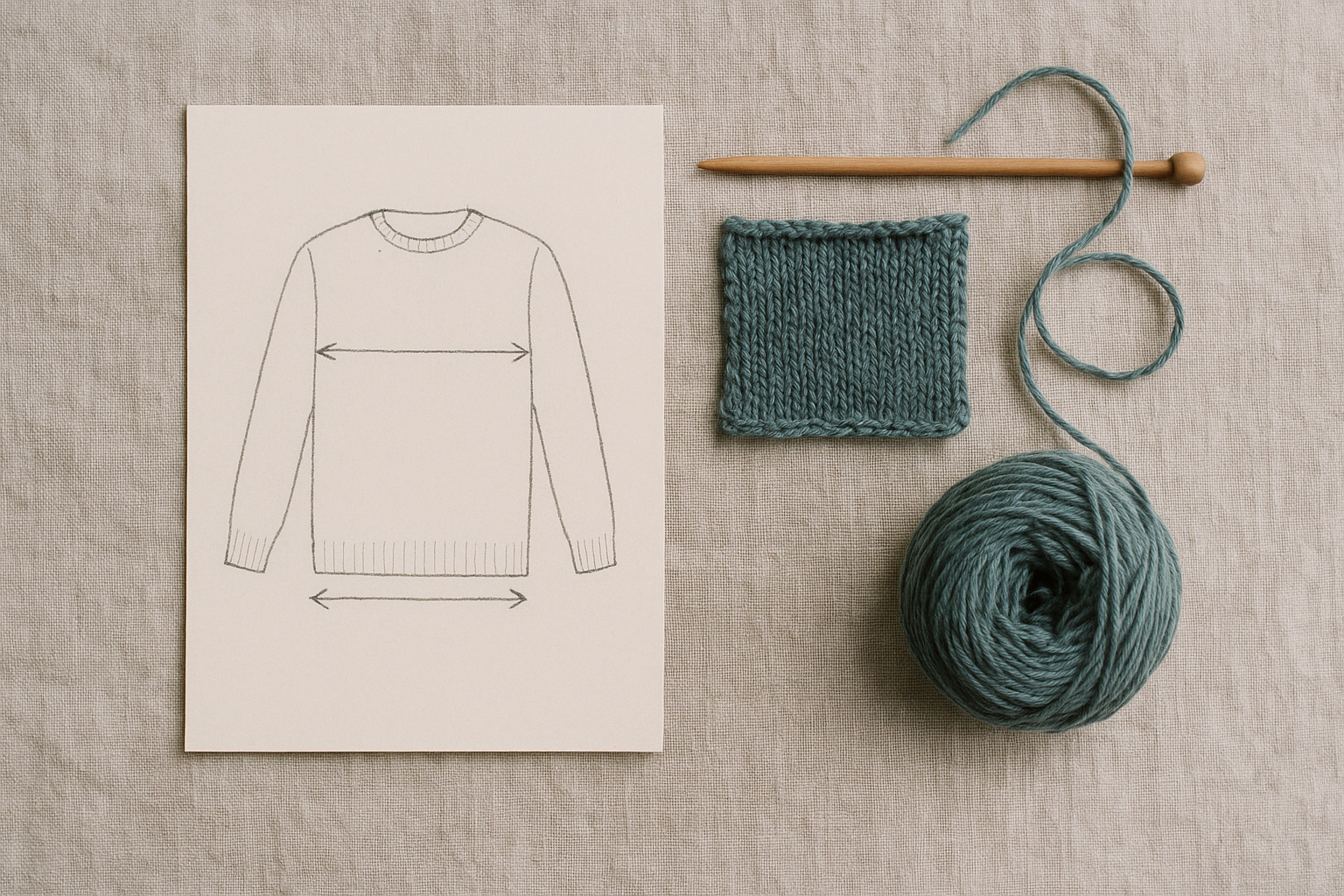
To grade a knitting pattern, you take one sample size and recompute its numbers for every other size: stitch counts from gauge times each finished measurement, row counts from gauge times each length, and shaping spread evenly so the count lands exactly on target. The gauge and the stitch pattern stay the same. Only the measurements change.
What grading actually is
Grading is not redesigning. The shape, the construction, and the gauge are fixed. You are answering one question for each new size: how many stitches and rows make this piece reach the finished measurements for that size? Every number on the pattern is just gauge multiplied by a measurement, then cleaned up to a count you can knit.
The finished measurements already include ease, so the math never adds any. If you want a 100 cm chest on the garment, you grade to 100 cm. The wearer's body and the chosen fit decided that number before you started counting stitches. For more on that, see ease and sizing basics.
Step 1: lock your gauge
Everything below depends on an accurate gauge, blocked and worked in the pattern stitch. If your gauge is off by one stitch over 10 cm, that error multiplies across hundreds of stitches and throws the whole size range off. Measure it carefully first, the way we cover in how to measure knitting gauge, and watch for the traps in gauge swatch mistakes.
Step 2: turn measurements into stitch counts
Take your stitch gauge per unit and multiply by the finished width for each size. Then round. A whole number of stitches almost never matches the target exactly, so round to the nearest stitch, or to the nearest pattern repeat if your stitch pattern needs it.
At a gauge of 20 stitches per 10 cm, a finished chest of 100 cm needs 100 divided by 10, times 20, which is 200 stitches around. Bump the chest to 110 cm and the same gauge gives 220 stitches. The gauge is constant; only the measurement moves.
Method: standard gauge-times-measurement grading, as taught in The Knitter's Handy Book of Patterns by Ann Budd (Interweave).If your stitch pattern repeats over, say, 4 stitches, round each size to a multiple of 4. The width changes by a stitch or two, far too little to feel, and the pattern stays unbroken at the join. A quick way to check any single number is the knitting calculator.
Step 3: do the same for length
Row counts use your row gauge the same way. Multiply rows per unit by the finished length you want, then round to a whole row. Most knitters drop row gauge and pay for it later, because the body length, armhole depth, and sleeve length all live in rows. Keep it in the math.
Step 4: spread the shaping evenly
This is where grading goes wrong most often. Say a sleeve runs from 44 stitches at the cuff to 60 stitches at the underarm over 80 rows. You need to add 16 stitches, which is 8 increase rows if you add one stitch each end per increase. 80 rows divided by 8 increases is one increase every 10 rows. That divides cleanly, so it is simple: increase 1 stitch each end every 10 rows, 8 times.
The trouble starts when it does not divide cleanly. A naive "every 8 rows" when the rows do not cooperate either runs out of fabric before you hit the target or lands you short of the count. The fix is to split the rate. Suppose you have 8 increases to fit across 56 rows. 56 divided by 8 is 7, so every 7 rows works. But if you had 56 rows and needed those 8 increases plus a tidier rhythm, you might increase every 6 rows 5 times, then every 8 rows 3 times. That is (6 times 5) plus (8 times 3), which is 30 plus 24, equal to 54 rows of shaping, with the final increase landing exactly on the target stitch count and a couple of plain rows to the underarm.
The principle holds for every shaped edge: waist, raglan, armhole, neck. Work out the total stitches to change and the rows available, divide to get the rate, and when it is uneven, use two rates so the last shaping row hits the exact count. Even shaping is what makes a graded size look intentional instead of lumpy.
Step 5: check the whole size run
Grade every size, then read down the columns. Stitch counts should climb in steady steps. No size should need a wildly different shaping rhythm than its neighbours. If one size jumps oddly, a rounding choice is usually the cause, and nudging it to the nearest repeat fixes it.
Let the tool do the arithmetic
Doing this by hand for one size is fine. Doing it for eight sizes, with shaping, is where slips creep in. Our free pattern grading generator takes your gauge, your size list, and your shaping points, then returns whole stitch counts, row counts, and even shaping for every size at once, plus a printable sheet. It is the best free way to grade without a single arithmetic error.
Sources
- Ann Budd, The Knitter's Handy Book of Patterns, Interweave: gauge-times-measurement method and size grading.
- TECHknitting, on shaping and distributing increases and decreases evenly (techknitting.blogspot.com).
- Craft Yarn Council, standard yarn weight and gauge guidelines (craftyarncouncil.com).
- Interweave knitting reference, on garment construction and grading practice.
Frequently asked questions
What does it mean to grade a knitting pattern?
Grading means taking one knitted sample size and recomputing every number so the pattern works across a full size range. You keep the same gauge and stitch pattern, then recalculate stitch counts, row counts, and shaping for each finished measurement.
How do I keep stitch counts whole when I grade?
Multiply your gauge by each finished measurement, then round to the nearest whole stitch. If the stitch pattern has a repeat, round to the nearest multiple of that repeat so the pattern lands evenly. The small change in width from rounding is almost always too tiny to feel.
How do I distribute shaping evenly across sizes?
Work out the total stitches to add or remove and the rows you have to do it in. Divide rows by the number of shaping steps. When it does not divide evenly, split it: for example increase every 6 rows several times, then every 8 rows for the rest, so the last step lands exactly on the target count.
Does grading add ease to the measurements?
No. Ease is already baked into the finished measurements you grade to. You pick finished chest, length, and sleeve numbers that include the wearing ease you want, then the grading math just converts those into stitches and rows.
Can I grade a pattern without doing the math by hand?
Yes. Our free pattern grading generator takes your gauge, your size list, and your shaping points, then outputs whole stitch counts, row counts, and even shaping for every size at once. It is the fastest way to grade without arithmetic slips.