How to count stitches in knitting
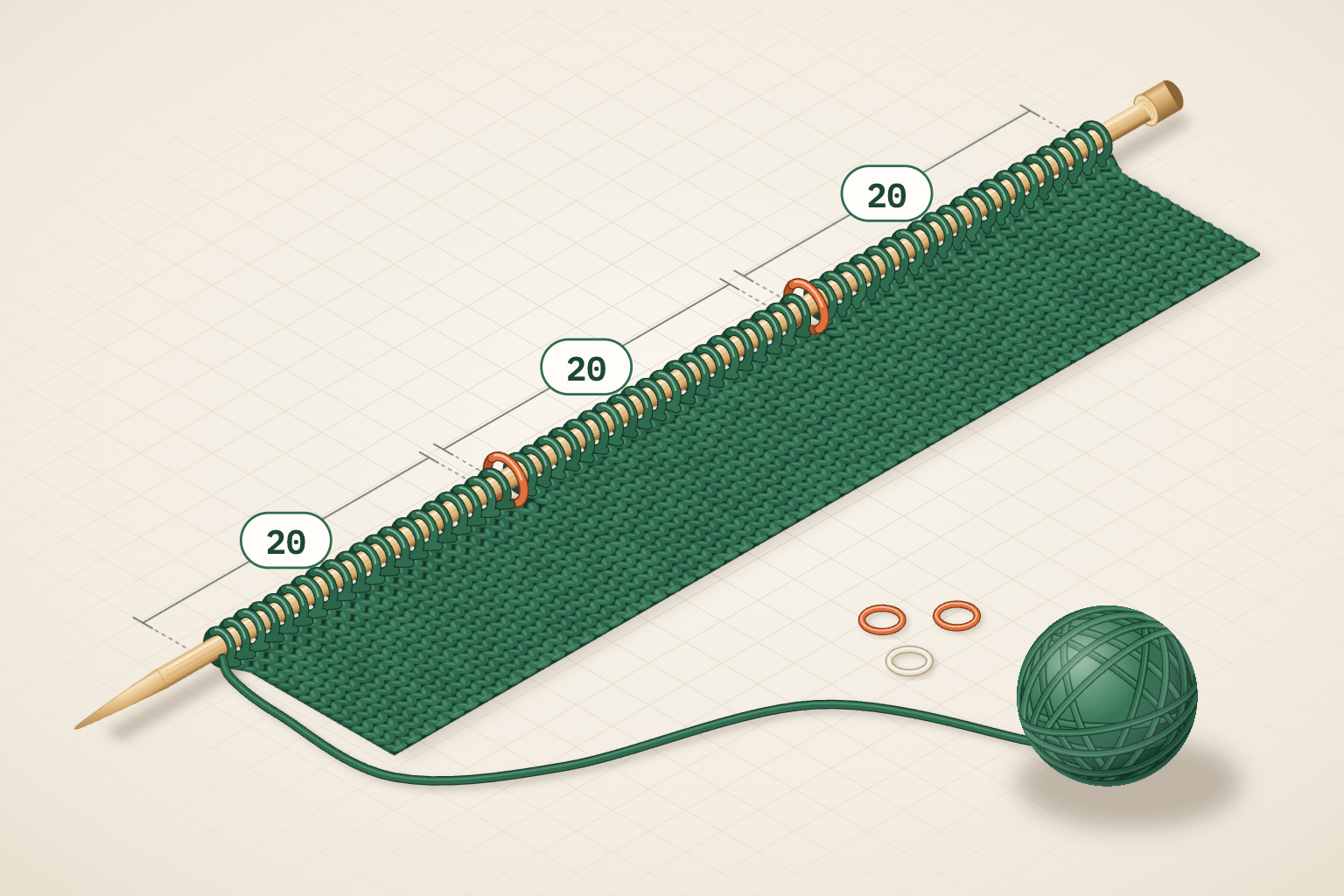
Every loop sitting on your needle is one stitch. Spread the loops out along the needle and count them in groups of 2 or 5, touching each group as you go. In the fabric, count the V's across one row of stockinette: each V is one stitch. Past about 40 stitches, stop counting the whole needle in one pass. Put a marker every 20 so a lost count costs you one group, not the lot.
The count matters because every stitch has a width. The Craft Yarn Council's Standard Yarn Weight System puts worsted yarn at 16 to 20 stitches over 4 in (10 cm). At 20 stitches per 10 cm, each stitch is 5 mm wide, so 4 stray stitches add 2 cm across a sweater front. Berroco's design team blog shows how easy the slip is: a 226-stitch sweater cast-on, counted with markers every 20, and one group turned out to hold 18. The markers turned a 226-stitch recount into an 18-stitch one.
Counting the stitches on your needle
Kate Atherley, writing for Modern Daily Knitting, says counting on the needle needs no special method. You count the loops. The hard part is seeing them, because stitches bunch at the needle tip and crowd onto the cable of a circular needle. So spread them out first.
Lay the work flat on a table. Push the loops along with a fingertip or the point of your other needle, one group at a time, and count in 2s or 5s. Touch each group as you count it. Your eye will skip a loop now and then. Your finger won't.
Count the slip knot. Knitting For Dummies is clear on this: the slip knot that starts a long-tail cast-on counts as the first real stitch, so a cast-on of 40 is the slip knot plus 39 more loops. Crochet works the other way, and that's where a lot of the confusion comes from: a crochet slip knot is not a stitch.
On double-pointed needles, count each needle and add them up. Hat patterns often split the stitches evenly, so 96 stitches on 4 needles is 24 a needle. A needle holding 23 or 25 tells you where to look. On a circular, start at the beginning-of-round marker and count all the way around to it.
What counts as a stitch?
A stitch is any loop on the needle that you will work into on the next row. A yarn over counts as soon as it's on the needle, and a decrease turns two loops into one. Markers never count. After any row that changes the total, check your needle against the number the pattern prints.
Here is how the common moves change the count:
- A yarn over (yo) wraps the yarn over the needle and makes a new loop. Knit Picks' tutorial says you work that loop like any other stitch on the next row, so 30 stitches with one yarn over become 31.
- A double yarn over (yo2) leaves two wraps. Knit Picks says to work each one on the next row, and warns that it's easy to miss one, which leaves you a stitch short and a big hole.
- Knit two together (k2tog), ssk and p2tog each work two stitches as one, so each one takes the count down by one.
- Increases such as make 1 (m1) and knit front and back (kfb) each add one.
- A lace row of "k2tog, yo" pairs keeps the same total, since every decrease is paid back by a yarn over.
- Ring markers on the needle and locking markers on the fabric are not stitches. Count around them.
Most patterns print the new total at the end of a row that changes it, written like "(88 sts)" after a hat decrease round. If you're unsure how to read that notation, see how to read a knitting pattern. Count your needle at every one of those totals. A crown that starts at 96 and loses 8 a round runs 88, 80, 72. If a round ends at 81, a decrease was missed in that round, not three rounds back, and you only have one round to search.
One exception catches lace knitters. Some lace patterns leave the yarn overs of the current row out of the printed total, and the pattern notes say so. Read the notes before you decide your count is wrong.
Source: Knit Picks, Yarn Over Increase (tutorials.knitpicks.com).How do you count stitches in the knitted fabric?
In stockinette, pick one row and count the V's along it from edge to edge. Each V is one stitch. Choose a row in the middle of the piece, away from the cast-on and the needle, and slide a blunt darning needle along under it so your eye has a line to follow.
Atherley points out the trap. Turn stockinette upside down and you still see tidy V's, offset by half a stitch, because the right leg of one stitch and the left leg of its neighbor form a V too. Seen the right way up, those look like little tents. You can count V's or tents, but count only one shape. Mixing the two along a row is how you end up one stitch over or under.
Source: Kate Atherley, Techniques in Depth: How to Count (moderndailyknitting.com).Other fabrics follow the same rule of one shape, one row:
- Reverse stockinette shows purl bumps, and each row has both up-facing and down-facing loops. Count only one. Or do what Atherley suggests and flip the piece over to count the V's on the knit side.
- Garter shows a ridge of downward curves (Atherley calls them umbrellas) and upward curves (smiles). The umbrellas are the tops of one row's stitches and the smiles are the bottoms of the next row's. Count one direction across a single ridge.
- Ribbing hides its purl columns. Stretch it sideways until they open up. In k2, p2 rib, count the knit ribs and the purl ribs, add them, and multiply by 2.
- Cables don't need counting inside the cross. The pattern tells you how many stitches each cable takes, so count the background stitches and add the cable widths. Three 6-stitch cables with 24 background stitches is 42.
Big cast-ons: place a marker every 20
Counting 200 loops in one pass rarely works. Someone talks to you, you lose your place, and you're back at stitch 1. The method on Berroco's blog: cast on 20, place a marker, cast on 20 more, place another. The post picks 20 because it's big enough to feel like progress and small enough to count while distracted. If you lose track, go back to the last marker and count only the loops after it.
A few refinements make it work better:
- Pick an interval that divides the total, or that matches the stitch repeat. A 120-stitch hat splits into six groups of 20. A lace pattern on an 8-stitch repeat counts well in groups of 16 or 24, so each marker sits on a repeat boundary.
- Expect a short last group. 226 stitches in groups of 20 is 11 full groups and 6 left over, and that tail gets counted on its own.
- Leave the markers in for the first few rows or rounds and count again. That second count is how Berroco caught the group of 18.
- Use markers that look different from your beginning-of-round marker. Loops of scrap yarn work fine.
Why does my stitch count keep changing?
The usual cause of a stitch gained at the start of every row is the working yarn. On a knit row it should hang at the back. If it's in front and you take it over the top of the needle to get it there, it wraps the needle and pulls the first stitch up so it looks like two loops. Knit both and you've added a stitch. Do that every row and the edge flares out into a triangle.
The fix is to bring the yarn under the needle to the back, then look at the first stitch before you work it. One loop is one stitch. On a purl row the same thing happens in reverse.
Ribbing has its own version mid-row. Switching from knit to purl, the yarn has to come forward between the needle tips. Take it over the needle instead and you've made a yarn over that the pattern never asked for.
Losing stitches has three common causes:
- A dropped stitch. Look down the fabric for a ladder of loose bars or a loop sitting on its own, catch it with a crochet hook, and work it back up.
- One loop of a double yarn over that slid past unworked.
- Two stitches knit together by accident, when the needle tip catches both loops at once.
Count after every shaping row and every 10 plain rows. A wrong count found on the row it happened takes a minute to fix. Found 30 rows later, it often means ripping back.
How to fix a count that's off by one or two
Count again first, in a different grouping. If you counted in 2s, count in 5s. Two different counts that agree beat one count done twice the same way.
Then use your markers to find the group that's wrong, and fix it to suit the fabric:
- In stockinette or garter, add or remove the stitch where it won't show. A k2tog or a make 1 next to a side marker or a seam disappears after blocking.
- In lace and cables, a wrong count means a yarn over or a decrease went missing inside a repeat, and patching it at the edge throws off every repeat after it. Unknit stitch by stitch (tink) back to the marker before the problem and work that group again. A lifeline, a strand of scrap yarn threaded through a row you know is right, gives you a safe place to rip back to.
- If the count is off by more than a handful, rip back to the last row where it was right.
Berroco's post used the side-marker fix for its short group: rather than cast on 226 stitches again, the author placed an extra marker as a reminder and added the 2 missing stitches at the side markers once the ribbing was done. In the comments, the author puts the limit for this fix at about 10 stitches.
Source: Berroco Design Team Blog, How to Knit a Sweater from the Bottom Up: Cast On Large Number of Stitches (blog.berroco.com).Where your stitch counts come from
Every cast-on number in a pattern is a gauge sum. Gauge is a stitch count over a set width, the stitches across 10 cm or 4 in of a blocked swatch, and you count it with the same V method above, half stitches included. How to measure knitting gauge covers the swatch, the blocking and where to put the ruler.
The sum: stitches to cast on = width in cm divided by 10, times your stitches per 10 cm. A 50 cm sweater front at 22 stitches per 10 cm is 5 times 22, so 110 stitches. The knitting gauge calculator does this from your swatch numbers, rounds to a whole stitch (or to your pattern's stitch multiple), and shows the width that count gives you. If your gauge doesn't match the pattern's, every count in it is off by the same ratio, and the knitting gauge converter rewrites those counts for your gauge.
Stitches give you width. Rows give you length, and they're counted up a column instead of across a row, which how to count rows in knitting walks through.
The short version
On the needle, count the loops in 2s or 5s, touching each group, and count the slip knot as stitch 1. In the fabric, count one row of V's and stick to one shape. Yarn overs and increases add a stitch, decreases take one away, and markers don't count. Over 40 stitches, place a marker every 20. Check the pattern's printed totals after each shaping row. If you keep gaining at the start of a row, bring the yarn under the needle, not over it.
Sources
- Kate Atherley, Techniques in Depth: How to Count (moderndailyknitting.com).
- Berroco Design Team Blog, How to Knit a Sweater from the Bottom Up: Cast On Large Number of Stitches (blog.berroco.com).
- Knit Picks, Yarn Over Increase (tutorials.knitpicks.com).
- Knitting For Dummies, How to Cast On with the Two-Strand Method (dummies.com).
- Craft Yarn Council, Standard Yarn Weight System (craftyarncouncil.com).
Frequently asked questions
Does the slip knot count as a stitch in knitting?
Yes. In knitting, the slip knot you start a cast-on with is your first stitch, so a cast-on of 40 is the slip knot plus 39 more loops. Crochet is the opposite: a crochet slip knot is not counted as a stitch, which is why the two crafts give different answers to this question.
Does a yarn over count as a stitch?
Yes, once it's on the needle. A yarn over makes a new loop, and you work that loop like any other stitch on the next row, so it adds one to the count. A double yarn over leaves two wraps, and each is worked. A few lace patterns leave the current row's yarn overs out of the printed total, and their notes say so.
Do stitch markers count as stitches?
No. A ring marker sits between stitches on the needle and a locking marker clips onto the fabric. Neither one is a loop you knit into, so count around them. Slip them from needle to needle as you reach them, and use a different color for the beginning-of-round marker so you don't mix them up.
Why do I have more stitches than I cast on?
The most common reason is the working yarn going over the top of the needle at the start of a row. That wraps the needle and makes the first stitch look like two loops, and knitting both adds a stitch. Bring the yarn under the needle to the back and check that the first stitch is a single loop.
How do you count stitches in garter stitch?
Count across one ridge. Each ridge shows downward curves (the tops of one row's stitches) and upward curves (the bottoms of the next row's stitches). Pick one direction and count only those curves from edge to edge. Counting both shapes doubles the number, and mixing them puts you one stitch off.