How to read knitting patterns
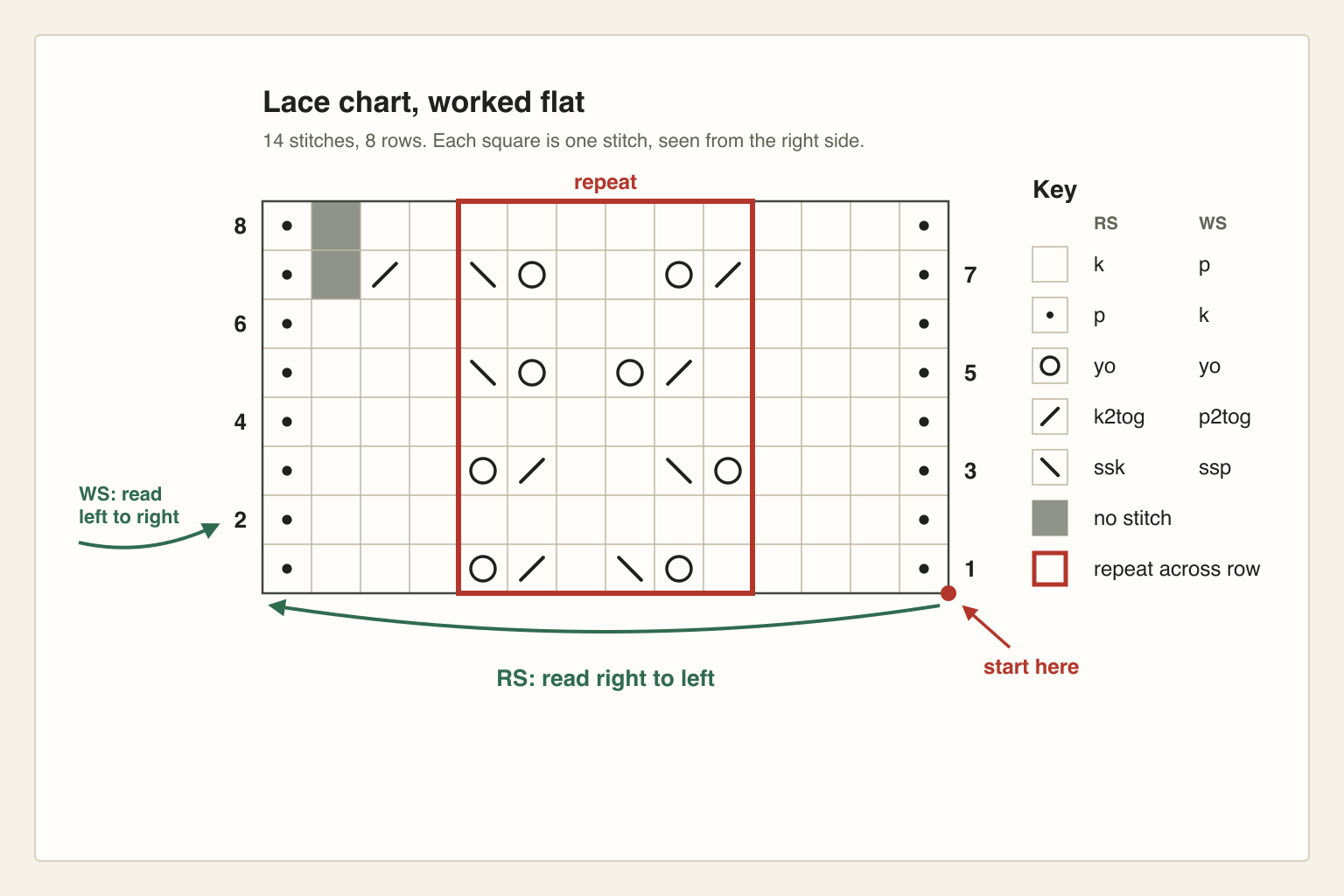
Read a knitting pattern in two passes. First, read the top section (yarn, needles, gauge, sizes and finished measurements) and pick your size before you touch the needles. Then work the instructions one row at a time, translating each abbreviation and repeat as you go. "K2, *p2, k2; rep from * to end" reads as a plain sentence once you know the shorthand: knit 2, then purl 2 and knit 2 over and over until you run out of stitches.
The shorthand is standard in the US. The Craft Yarn Council (CYC), the yarn industry's trade group, publishes a master list of abbreviations and chart symbols, and most English-language patterns follow it. Learn about 20 of them and you can read most patterns written today.
What's in a knitting pattern?
Almost every pattern has the same parts in the same order: a skill level, sizes and finished measurements, materials (yarn, needles, notions), gauge, abbreviations and special stitches, then the instructions, and last the finishing (seaming, blocking, weaving in ends). Many sweater patterns add a schematic, a line drawing of each piece with its measurements.
Don't skip ahead to "Cast on." The top section holds three things that decide whether the project fits.
- The skill level. CYC uses four: Basic, Easy, Intermediate and Complex. Basic means plain stitches with maybe a few increases and decreases. Complex means lace, cables or colorwork combined with shaping at the same time.
- The yarn weight. A pattern calling for worsted is a CYC #4 (Medium) yarn, which CYC lists at 16 to 20 stitches per 4 in (10 cm) on 4.5 to 5.5 mm needles (US 7 to 9). What is worsted weight yarn covers that category in detail.
- The gauge line, which tells you how many stitches and rows the designer got over 4 in.
Knitting abbreviations you'll see on every page
These come from the CYC master list. A pattern may define its own extras in the abbreviations section, so check there before you guess.
- k: knit. p: purl. st(s): stitch(es). st st: stockinette stitch.
- CO: cast on. BO: bind off.
- RS: right side, the side that faces out when worn. WS: wrong side.
- k2tog: knit 2 together, a decrease that leans right.
- ssk: slip, slip, knit (slip 2 stitches knitwise one at a time, then knit them together through the back loops), a decrease that leans left.
- yo: yarn over, an increase that leaves a small hole.
- M1: make one, an increase with no hole.
- sl: slip. tbl: through the back loop. wyif: with yarn in front.
- pm: place marker. sm: slip marker.
- rep: repeat. rnd: round. beg: beginning. inc: increase. dec: decrease. patt: pattern.
Two of them cause most beginner errors. A yo adds a stitch and a k2tog removes one, so "yo, k2tog" keeps your count level. Leave out a yo and your count drops by one every time. And "sl 1" with no direction given means slip it purlwise (insert the needle as if to purl) unless the pattern says knitwise.
How do you read the sizes in parentheses?
The first number belongs to the smallest size, and the numbers in parentheses belong to the larger sizes, in the same order as the size list. Find where your size sits in that list (third, say) and use the third number every single time it appears, for stitches, rows, lengths and repeats.
Tin Can Knits uses their Barley hat to show it. The pattern says "cast on 66 (72, 78, 84, 90, 96) sts," and the sizes run Baby, Toddler, Child, Adult S, Adult M, Adult L. Adult S is fourth, so you cast on 84. Later the hat says to knit until it measures 4 (5, 6, 7, 8, 8.5) in. Adult S is fourth again, so 7 in.
Before you cast on, go through the whole pattern and highlight your number in every line. On a PDF you can do this with the highlighter tool. It takes five minutes and stops the classic mistake of casting on for one size and shaping for another.
If a size has a 0 or a dash in its spot, that step doesn't apply to your size. Skip it and move on.
How to read repeats: asterisks, brackets and parentheses
CYC defines four repeat marks:
- A single asterisk (*) means repeat what comes after it, as directed. "K2, *p2, k2; rep from * to end" means knit 2 once, then repeat "p2, k2" until the row is done.
- Two asterisks (*...*) frame a section to repeat a set number of times.
- Square brackets [ ] mean work what's inside as many times as stated. "[k2tog, yo] 4 times" is 8 stitches of work: k2tog, yo, k2tog, yo, k2tog, yo, k2tog, yo.
- Parentheses ( ) also mark a group, or a group of stitches all worked into one stitch, like "(k1, p1, k1) in next st."
Watch the difference between "rep from * to end" and "rep from * 3 more times." The second means four repeats in total: the one you already worked plus three more.
Use the repeat to check the cast-on. A row of "k2, *p2, k2; rep from *" needs a stitch count that's a multiple of 4, plus 2. That's why a pattern in this rib would cast on 90 (98, 106) sts: 22, 24 and 26 repeats of 4, plus 2 each. If your count won't divide that way, you've miscounted, and you'll find out at the end of the first row.
The pattern phrases that trip people up
A few plain-English phrases carry more instruction than they seem to.
- "Work even" means keep going in the stitch pattern you're in, with no increases or decreases. Lion Brand and Berroco both define it that way. You knit the knits and purl the purls as they face you.
- "Ending with a WS row" means stop after a wrong-side row, so the next row you work is a right-side row.
- "Work until piece measures 7 in from cast-on edge" means measure flat, from the cast-on to the needle, not along a curl or a stretched edge.
- "Reverse shaping" means work the other side as a mirror. Shaping you did at the start of RS rows on one front happens at the start of WS rows on the other.
- "At the same time" means two sets of shaping happen together. Interweave's cardigan example binds off for the armhole at the start of RS rows while it decreases for the neckline at the end of the same rows.
That last phrase deserves a warning. It often comes in the middle of a long paragraph, and knitters find it after they've passed the row where it started. Read every shaping section to the end before you work its first row. A pencil grid with one line per row, marking which rows get armhole and which get neck shaping, takes ten minutes and saves ripping back.
Source: Interweave, on "at the same time" instructions (interweave.com).Check the gauge line before you cast on
The gauge line is the most important number on the page. It reads like "18 sts and 24 rows = 4 in (10 cm) in st st on US 8 (5 mm) needles, after blocking." The designer's stitch counts only produce the listed measurements at that gauge.
Here's what a small miss does. A sweater front cast on with 90 sts at 18 sts per 4 in is 20 in (50 cm) wide. Knit those 90 sts at 20 sts per 4 in and the front comes out 18 in (45 cm). That's 2 in narrower on the front, 4 in on the whole body, from two extra stitches over 4 in.
So knit a swatch, block it the way you'll block the finished piece, and count. How to measure knitting gauge shows the counting. If your number won't match even after a needle change, the knitting gauge converter recalculates the pattern's stitch and row counts at your gauge. What to do when gauge doesn't match covers when to change needles and when to change the math.
How do you read a knitting chart?
Read a chart from the bottom up, starting at the bottom right corner. Each square is one stitch and each row of squares is one row of knitting, shown as the fabric looks from the right side. Worked flat, you read RS rows right to left and WS rows left to right. Worked in the round, you read every round right to left.
The row numbers tell you which is which. On a flat chart, odd numbers (RS rows) sit on the right edge and even numbers (WS rows) on the left. If the numbers only run 1, 3, 5, 7, the chart shows RS rows only, and the pattern text tells you what to do on the WS rows (often "purl all sts").
Read the key every time. Symbols aren't fully standard, and DMC's chart guide makes the same point. CYC's chart symbols show why the key has two columns: a stitch drawn as a knit means knit on a RS row but purl on a WS row, because the chart shows the RS face. The same goes for decreases. CYC's k2tog symbol means k2tog on RS and p2tog on WS, and its ssk symbol means ssk on RS and ssp on WS. In the round, every round is a RS round, so you use the RS column only.
Three more marks show up often:
- A heavy or colored outline is a repeat box. Work the stitches before it once, repeat the boxed stitches across, then work the stitches after it.
- Grey or black squares are "no stitch" squares, which CYC defines as places where stitches don't exist. They hold the grid's shape where a decrease has removed a stitch. Skip over them.
- A cable symbol stretches across several squares. A C4F covers four, because it's worked over four stitches.
Keep your place with a ruler or a strip of sticky note laid above the row you're working, so the rows you've finished stay visible below it. Your knitting should match the chart below the line. If it doesn't, you've found the mistake before it travels.
A worked example, line by line
Here's a short flat section and how to read it for the second of three sizes:
"CO 90 (98, 106) sts. Row 1 (RS): K2, *p2, k2; rep from * to end. Row 2 (WS): P2, *k2, p2; rep from * to end. Rep Rows 1 and 2 until piece measures 2 (2, 2.5) in, ending with a WS row."
- Cast on 98 stitches, the second number.
- Row 1: knit 2, then repeat "purl 2, knit 2" 24 times. That's 2 + 96 = 98 stitches.
- Row 2: purl 2, then repeat "knit 2, purl 2" to the end. You're working the stitches as they face you, so the ribs line up.
- Keep alternating those two rows until the ribbing is 2 in, and stop after a Row 2.
If you want to see where those numbers come from, how to grade a knitting pattern shows how a designer turns one size into 90, 98 and 106. And the pattern grading generator does that math for every size from your gauge and measurements.
Before you start: a five-minute checklist
- Read the pattern top to bottom once, finishing included.
- Pick your size from the finished measurements, not your body measurements. Ease and sizing basics explains how much bigger than you the garment should be.
- Highlight your size's number in every line.
- Look up any abbreviation you don't know in the pattern's own list first, then CYC's.
- Knit, block and measure a gauge swatch.
- Find every "at the same time" and every "reverse shaping" and mark them.
- Check the pattern's page for errata. Corrections get posted after a pattern goes out.
Sources
- Craft Yarn Council, Knitting Abbreviations Master List, Knit Chart Symbols, Standard Yarn Weight System and Project Levels (craftyarncouncil.com).
- Tin Can Knits, Reading Multi-Size Knitting Pattern Instructions, for the multi-size numbers and the Barley hat example (blog.tincanknits.com).
- DMC, How to Read a Knitting Chart, for chart direction, RS-only charts, repeats and cable widths (dmc.com).
- Interweave, on "at the same time" instructions (interweave.com).
- Lion Brand, Understanding Common Pattern Terms (blog.lionbrand.com), and Berroco, What Does Work Even Mean (blog.berroco.com).
Frequently asked questions
What does * mean in a knitting pattern?
An asterisk marks the start of a repeat. "K1, *k2tog, yo; rep from * to last st, k1" means knit 1, then work "k2tog, yo" over and over until one stitch is left, then knit it. When two asterisks frame a section, repeat that section the number of times the pattern gives.
What do the numbers in brackets mean in a knitting pattern?
In a multi-size pattern, the first number is for the smallest size and the numbers in parentheses are for the larger sizes, in order. In an instruction like "[k2, p2] 3 times," square brackets mean work the stitches inside them the stated number of times.
What does "work even" mean in knitting?
It means continue in the established pattern with no increases or decreases. In stockinette you keep knitting the RS rows and purling the WS rows. In ribbing you knit the knits and purl the purls as they face you, until you reach the length or row count the pattern gives.
Do you read a knitting chart from right to left?
On right-side rows, yes. Start at the bottom right corner and read RS rows right to left. On a flat piece, read WS rows left to right. In the round, every round is a RS round, so read every row right to left.
Are UK and US knitting patterns written the same way?
Yes, with a few different words. UK patterns say "cast off" for bind off, "tension" for gauge and "stocking stitch" for stockinette, and older UK patterns give needles in a number system that runs the opposite way from US sizes. Go by the metric size in millimeters when a pattern gives it.