What is worsted weight yarn?
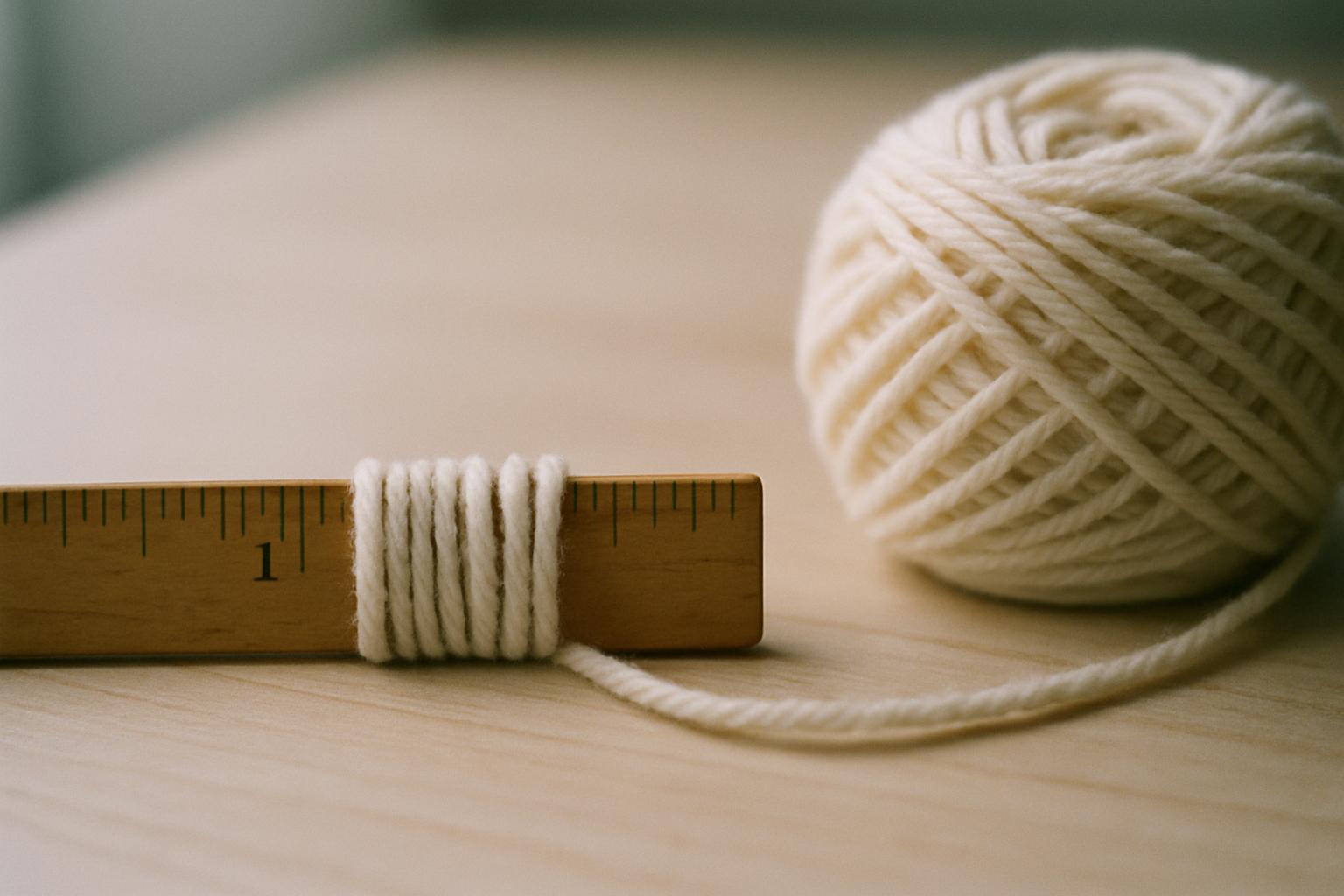
Worsted weight yarn is a medium yarn, weight category 4 in the Craft Yarn Council system. On a standard ball band it knits to 16 to 20 stitches over 4 inches (10 cm) in stockinette, on US 7 to 9 needles (4.5 to 5.5 mm). It is the middle of the yarn range and the thickness most patterns assume, which is why so many sweaters, hats, and blankets call for it.
What "worsted weight" actually means
Yarn weight is about thickness, not how heavy the ball feels in your hand. The Craft Yarn Council sorts yarn into eight numbered categories, from 0 lace up to 7 jumbo, and worsted sits at 4, labelled "medium." The category also covers yarns sold as aran and afghan, so a ball marked any of those three is weight 4.
That single number is a shortcut for a whole cluster of facts: roughly how many stitches the yarn makes per inch, what needle it likes, and what it will feel like knitted up. Worsted is popular because it lands in a friendly spot. It is thick enough to knit fast and show stitch texture, thin enough for a wearable sweater, and easy to find in almost any fiber and color.
One caution about the word itself. "Worsted" also names a spinning method, a smooth, tightly prepared yarn where the fibers all run the same way. That meaning has nothing to do with thickness. When a pattern says worsted weight, it means the size, not how the yarn was spun.
The Craft Yarn Council measures a category 4 yarn at 16 to 20 stitches per 4 in (10 cm) in stockinette, on 4.5 to 5.5 mm needles (US 7 to 9). Every yarn weight on the council's chart is defined by that same 4 in gauge window, which is why ball bands and patterns quote gauge the same way.
Source: Craft Yarn Council, Standard Yarn Weight System (craftyarncouncil.com).How do you know if a yarn is worsted weight?
Check the ball band first. Look for the number 4 inside a little skein symbol, or a knit gauge printed as 16 to 20 stitches over 4 in. No band? Wrap the yarn snugly around a ruler for one inch and count. A worsted strand gives about 9 to 12 wraps per inch.
Reading the ball band
Most bands print a small square with a knitting swatch, a number, and two gauges: one for knitting and one for crochet. A weight 4 band shows 16 to 20 knit stitches per 4 in and 11 to 14 single crochet stitches per 4 in, with a suggested needle of US 7 to 9 and a hook around 5.5 to 6.5 mm (I-9 to K-10.5). Those are starting points the maker prints, not a promise about your hands.
The wraps per inch test
Wraps per inch, or WPI, rescues a yarn that lost its band. Wind the strand around a pencil or ruler, snug but not stretched, with no gaps and no overlaps, and count how many wraps fill one inch. Do it two or three times and average. Nine to twelve wraps points to worsted. Fewer wraps means a thicker yarn like bulky, more wraps means something finer like DK.
Worsted vs DK, aran, and bulky
The neighbors on either side are close enough to mix up in a shop, so here are the numbers that separate them:
- DK (weight 3, light): 21 to 24 stitches per 4 in, US 5 to 7 needles. A step finer than worsted.
- Worsted (weight 4, medium): 16 to 20 stitches per 4 in, US 7 to 9 needles.
- Aran (also weight 4): grouped with worsted, but usually knit at the thicker end, nearer 16 to 18 stitches per 4 in and US 8 to 9. British patterns lean on the word aran where American ones say worsted.
- Bulky (weight 5): 12 to 15 stitches per 4 in, US 9 to 11 needles. Noticeably chunkier and faster.
Aran and worsted overlap enough that many yarns could wear either label, and the council files both under category 4. If you are subbing one for the other, trust the printed gauge over the name.
What size needles do you use for worsted weight yarn?
The ball band suggests US 7 to 9 (4.5 to 5.5 mm), and that is the right place to start. But the needle on the band is a suggestion, not your answer. You pick the needle that hits the gauge your pattern asks for, then adjust from there: a larger needle for looser, drapier fabric, a smaller one for a dense, hard-wearing knit.
That is why two knitters can use the same worsted yarn on US 8 needles and get different fabric. Hand tension varies, so the needle is a dial you turn until the swatch matches, not a rule you obey.
How much worsted weight yarn do you need?
Worsted usually runs about 170 to 240 yards per 100 g skein, so a "100 gram ball" is not a fixed length. Check the yardage on the band, because that is what a pattern actually counts.
As a rough guide, a hat takes one skein, a scarf takes two or three, and an adult sweater runs somewhere near 1,000 to 1,500 yards depending on size and length. Always buy from the same dye lot for a single project, and buy one extra skein for a garment. Running short two rows from the bind-off, then finding a mismatched lot, is a common and avoidable heartbreak.
Why two worsted yarns can knit up differently
Here is the part that trips people up. Two balls both labelled worsted can still knit to different gauges. A springy wool, a drapey cotton, and a slick acrylic behave differently on the same needle, and ply and fiber shift the numbers even within weight 4. The category gets you close. It does not get you exact.
So a worsted label is a starting point, not a guarantee your knitting will match the pattern. The fix is the same as always: knit a swatch in your yarn, block it, and measure. Read how to measure knitting gauge for the method, and gauge swatch mistakes for the errors that quietly skew the count.
Once you have your real numbers, the math is quick. Drop your gauge into the knitting calculator to turn a measurement into stitches and rows, or the pattern grading generator to size a whole garment. Swapping a pattern's yarn for a different weight? The gauge converter recomputes the counts so the finished size stays put, and what to do when gauge does not match walks through your options.
The short version
Worsted weight is medium yarn, category 4, knitting to 16 to 20 stitches over 4 inches on US 7 to 9 needles, with 9 to 12 wraps per inch. It is the default thickness for most patterns and the easiest weight to find. Just remember the label puts you in the right neighborhood, not the exact house. Your swatch does that.
Sources
- Craft Yarn Council, Standard Yarn Weight System (craftyarncouncil.com).
- Lion Brand, worsted weight yarn weight reference and gauge notes (lionbrand.com).
- Sarah Maker, yarn weights guide and wraps-per-inch chart (sarahmaker.com).
Frequently asked questions
What is worsted weight yarn?
Worsted weight is a medium yarn, weight category 4 in the Craft Yarn Council system. It knits to 16 to 20 stitches over 4 inches in stockinette on US 7 to 9 needles (4.5 to 5.5 mm), and it is the all-purpose middle of the yarn range used for most sweaters, hats, and blankets.
Is worsted weight the same as aran?
Almost. The Craft Yarn Council groups worsted, aran, and afghan together as weight 4. In practice aran runs a touch thicker, closer to 16 to 18 stitches per 4 inches, and British patterns use "aran" where American ones say "worsted." If you are substituting, match the printed gauge rather than the name.
What needle size is worsted weight yarn?
The standard suggestion is US 7 to 9 (4.5 to 5.5 mm). Treat it as a start. You choose the needle that gives your pattern's gauge, going up a size for softer drape or down a size for a firmer fabric, then confirm with a blocked swatch.
How many wraps per inch is worsted weight?
About 9 to 12. Wrap the yarn snugly around a ruler for one inch, no gaps and no overlaps, and count. Nine to twelve wraps confirms worsted. Fewer means a bulky yarn, more means a finer one like DK.
How many yards are in a skein of worsted weight yarn?
Usually 170 to 240 yards per 100 g, though it varies by brand and fiber. Read the yardage on the band, since patterns count length, not weight. For a garment, buy an extra skein from the same dye lot so you do not run short.