How to count rows in knitting
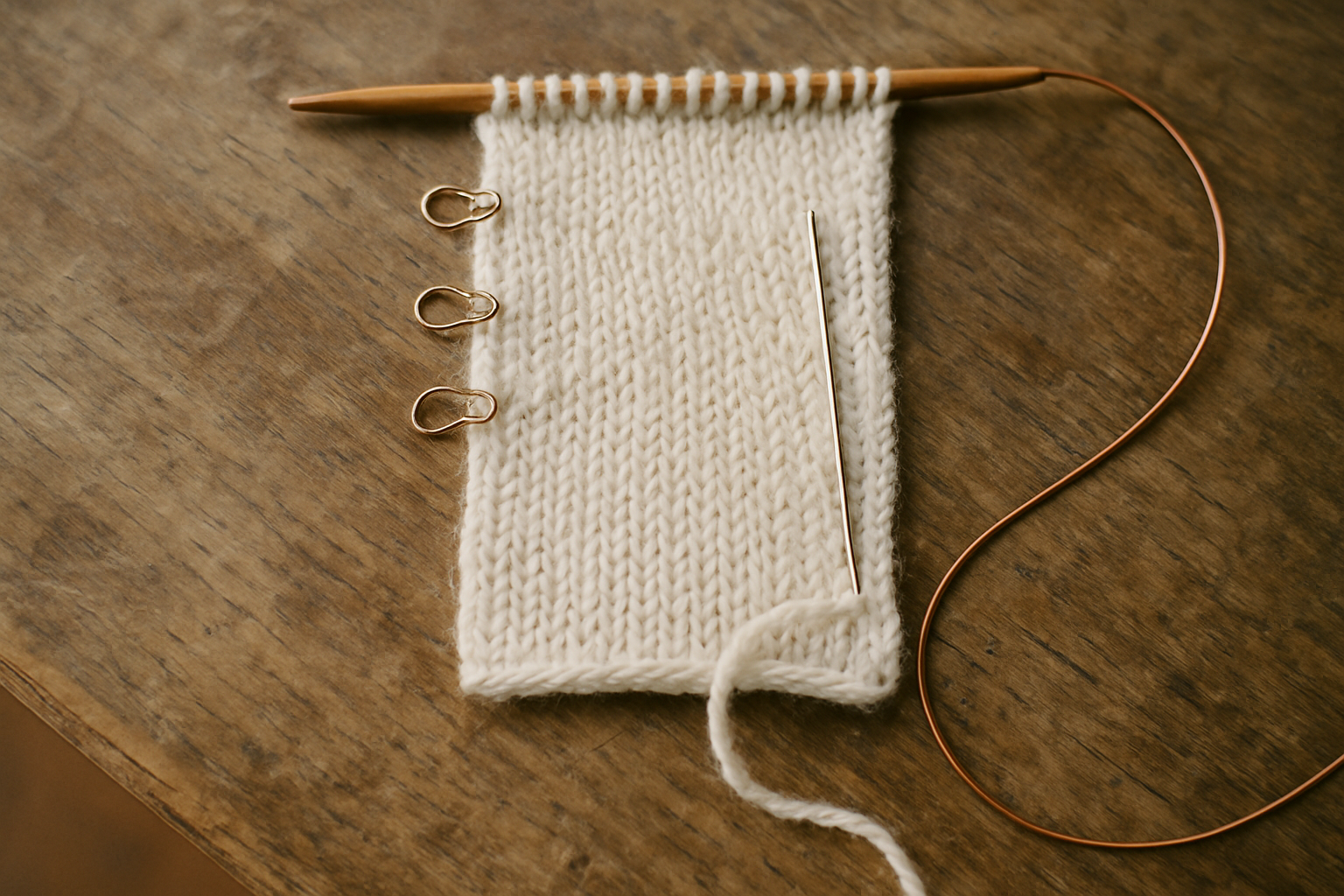
Pick one column of stitches and count upward from the cast-on edge to the needle. In stockinette every V is one row. In garter every ridge is two. The loops on your needle are the last row you worked, so they count. What trips people up is the bottom edge: a long-tail cast-on makes a row of stitches as it goes, a backward-loop cast-on does not, and that one difference is why two knitters counting the same swatch get numbers one apart.
Rows matter more than most beginners expect. In stockinette a stitch is wider than it is tall, so Ysolda Teague's gauge primer gives 5 stitches and 7 rows to the inch, or 20 stitches and 28 rows over 10 cm. A pattern that says "work 45 cm" at that gauge means 126 rows, and every row you miscount moves the hem by 3.6 mm.
Stockinette: follow one column of V's
Hold the piece with the knit side facing you. Each knit stitch is a V made of two slanted strands, and the V's stack in neat columns. Choose one column near the middle, not at the selvedge where the edge stitches stretch. Start at the first V above the cast-on edge and count each V up the column until you reach the needle. Then add the loop sitting on the needle in that column. That loop is the row you finished last.
Two tricks make the column easier to hold. Slide a darning needle up it so your eye has a line to follow, and stretch the fabric a little sideways so the V's separate. On dark yarn, turn to the purl side instead: each row is a line of bumps, and the bumps in one column alternate left and right, which makes them easy to pair off.
Stripes show why the loops on the needle count. Patty Lyons's example: if a pattern wants 8 rows of a color and you wait until you can see 8 V's below the needle before switching, you've knit 9. The eighth row was already on the needle when you counted 7 V's.
Does the cast-on row count as a row?
No, in almost every pattern. "Cast on 40 stitches and work 20 rows" means 20 rows after the cast-on, and row 1 is the first row you knit into those loops. Paper Moon Knits and NobleKnits both state it that way, and it's the safe reading of any pattern that doesn't say otherwise.
Reading your own fabric is different, and this is where the cast-on method matters. The long-tail cast-on builds a row of knit stitches at the same time as it makes the loops, so a long-tail edge already shows one row of V's before you knit anything. A knitted cast-on or a backward-loop cast-on makes loops and nothing else. Patty Lyons's rule follows from that. After a long-tail cast-on, the V's below the needle equal the rows you have worked, because the cast-on's own row and the row still on the needle cancel each other out. After a knitted or backward-loop cast-on, count the V's below the needle and add one for the needle.
Test it once on a swatch you cast on with long tail. Work exactly 10 rows, then count V's below the needle in one column. You'll find 10, and the bottom one belongs to the cast-on.
Source: Patty Lyons, Tuesday Tip: How to Count Rows (pattylyons.com); NobleKnits, Does the Cast On Row Count as Row 1? (nobleknits.com).Garter stitch: count the ridges and double them
Garter is knit every row, so the fabric is horizontal ridges with a valley between each pair. Every ridge is 2 rows: one row makes the bumps you see on the front, the next row makes the bumps that show on the back. Count the ridges on the side facing you and multiply by 2.
Paper Moon Knits adds the check that catches an odd row count. Count the ridges on the front, then flip and count the ridges on the back. If both sides show the same number, you have worked an even number of rows. If the front shows 5 ridges and the back shows 4, you've worked 9. The cast-on edge looks like a ridge on one side, and it isn't one, so leave it out.
Ribbing, seed stitch and cables
Ribbing hides its rows because the purl columns sink. Stretch the fabric sideways, choose one knit column, and count the V's in that column alone. Counting across the row gives you stitches, not rows.
Seed and moss stitch alternate knit and purl within a column, so there are no clean V's to follow. Pick a column anyway and count the loops stacked in it, whichever way each loop faces. Each loop is one row.
Cables are counted from a landmark. Find the last cross, then the first row above it where the cable's stitches sit as plain V's side by side. That is row 1 after the cross, and you count up from there. Nimble Needles recommends a locking marker on the cross row so you never have to hunt for it.
How do you count rounds when knitting in the round?
Each round is one row, and you count the same way: one column of V's, cast-on edge to needle. The difference is that a round is a spiral, not a stack of closed rings, so mid-round the column to the right of the working yarn is one V taller than the column to its left. Paper Moon Knits puts it this way: count to the left of the working yarn for rounds you have finished, and to the right of it for the round you are on.
The simplest habit is to stop at the marker before you count. With the yarn at the marker there is no round in progress, so the column right before the marker holds every round you have worked, and the column right after it is one round behind.
Stop counting: mark every ten rows
Counting a whole sleeve from the cuff is slow and easy to get wrong. The fixes cost nothing.
- Clip a locking stitch marker or a safety pin to the selvedge every 10 rows. Lion Brand suggests split rings in a contrasting color. At 28 rows per 10 cm a marker lands every 3.6 cm, and from then on you count markers, not rows.
- Use a row counter, and click it at the end of a row, never the start. If you can't remember whether you clicked, the fabric tells you: the counter should match the V's plus the row on the needle.
- For lace and cables, thread a lifeline through the loops on the needle at the end of a pattern repeat. It marks the row and gives you a row to rip back to.
- On mohair or black yarn, mark every 10 rows from the start. You won't be able to read that fabric later.
Why the row count matters more than the tape measure
Row gauge is the number of rows over 10 cm or 4 in, and it is a separate figure from stitch gauge. A knitter can match a pattern's 20 stitches over 10 cm and still get 26 rows where the designer got 28, because changing needle size to fix width doesn't fix height in the same proportion. The Craft Yarn Council's Standard Yarn Weight System lists only stitch gauge per category, so row gauge is always a number you measure yourself.
Measuring a live piece with a tape is unreliable. Fabric on the needle is under tension, unblocked, and it stretches when you hold it up. A row count is fixed. So convert the pattern's length to rows once, then count.
The arithmetic: rows to knit = target length divided by 10 cm, times your row gauge per 10 cm. NobleKnits runs it in inches: a 10 in section at 22 rows per 4 in is 10 divided by 4, times 22, which is 55 rows. In her example the designer's gauge needed 63 rows for the same section. Knit 63 at 22 rows per 4 in and that piece comes out about 1.5 in too long.
Source: NobleKnits, What's the Deal with Row Gauge? (nobleknits.com).In metric: a sleeve of 46 cm at 28 rows per 10 cm is 4.6 times 28, which is 128.8, so 129 rows. The knitting calculator does this from your gauge and your target length, rounds to a whole row, and shows the drift between the rounded count and the length you asked for.
Raglans and hat crowns are where row gauge bites hardest, because the decrease rows are fixed by the pattern. A raglan that decreases every other row for 32 rows is 32 rows tall whatever your gauge is, so rows 10 percent shorter than the designer's give an armhole 10 percent shallower. The knitting gauge converter rewrites a pattern's row counts to your gauge so the lengths hold, and when your gauge doesn't match the pattern walks through the choices before you start.
None of this works if the gauge number was wrong to begin with. Blocking changes row gauge, and superwash wool in particular is known for growing longer once wet, so count rows on a blocked swatch. How to measure knitting gauge covers counting stitches and rows across the middle of a blocked swatch, and gauge swatch mistakes covers the small swatch and the unblocked swatch, the two that produce a confident wrong number.
The short version
One column, cast-on edge to needle. Stockinette: every V is a row, and the loop on the needle counts. Garter: ridges times 2, and compare front to back to catch an odd row. Rounds: stop at the marker and count the column right before it. Cast-on: not a row in the pattern, but a long-tail edge shows one V row of its own, so after long tail the V's below the needle are your row count, and after any other cast-on you add one. Mark every 10 rows. Convert lengths to rows before you start, then count instead of measuring.
Sources
- Patty Lyons, Tuesday Tip: How to Count Rows (pattylyons.com).
- NobleKnits, Does the Cast On Row Count as Row 1? and What's the Deal with Row Gauge? (nobleknits.com).
- Paper Moon Knits, Math Monday: Counting, Part 2, Rows/Rounds (papermoonknits.com).
- Nimble Needles, How to count rows in knitting (nimble-needles.com).
- Lion Brand, The Ups and Downs of Knitting: Counting Your Rows (lionbrand.com); Handy Little Me, How to Count Rows in Knitting (handylittleme.com).
- Ysolda Teague, Learn to Knit: Gauge 101 (ysolda.com).
- Craft Yarn Council, Standard Yarn Weight System (craftyarncouncil.com).
Frequently asked questions
Does the cast-on count as a row in knitting?
Not in the pattern. "Cast on and work 20 rows" means 20 rows after the cast-on, and row 1 is the first row you work into the loops. When reading your fabric, a long-tail cast-on shows one row of V's of its own, so the V's below the needle equal your rows worked. After a knitted or backward-loop cast-on, add one for the row on the needle.
Do the stitches on the needle count as a row?
Yes. The loops on the needle are the row you just finished, so include them. If a pattern wants 8 rows of a stripe and you wait until 8 V's are visible below the needle, you have knit 9 rows. Count 7 V's plus the row on the needle, then switch colors.
How many rows is one garter stitch ridge?
Two. One row forms the bumps on the front and the next forms the bumps on the back, so count the ridges on one side and multiply by 2. If the front shows one more ridge than the back, the row count is odd. The cast-on edge looks like a ridge and is not one.
How do I count rows when knitting in the round?
Each round is one row, so count one column of V's from the cast-on to the needle. Rounds spiral, so mid-round the column to the right of the working yarn is one V taller than the column to its left. Stop at the marker and count the column right before it: with no round in progress, that column holds every round you have worked.
How do I convert a length in a pattern to rows?
Divide the target length by 10 cm (or 4 in) and multiply by your row gauge over that distance. A 46 cm sleeve at 28 rows per 10 cm is 4.6 times 28, or 129 rows. The knitting calculator on this site does the division and rounding for you. Measure row gauge on a blocked swatch, since blocking changes it.