Knitting vs crochet: what's the difference?
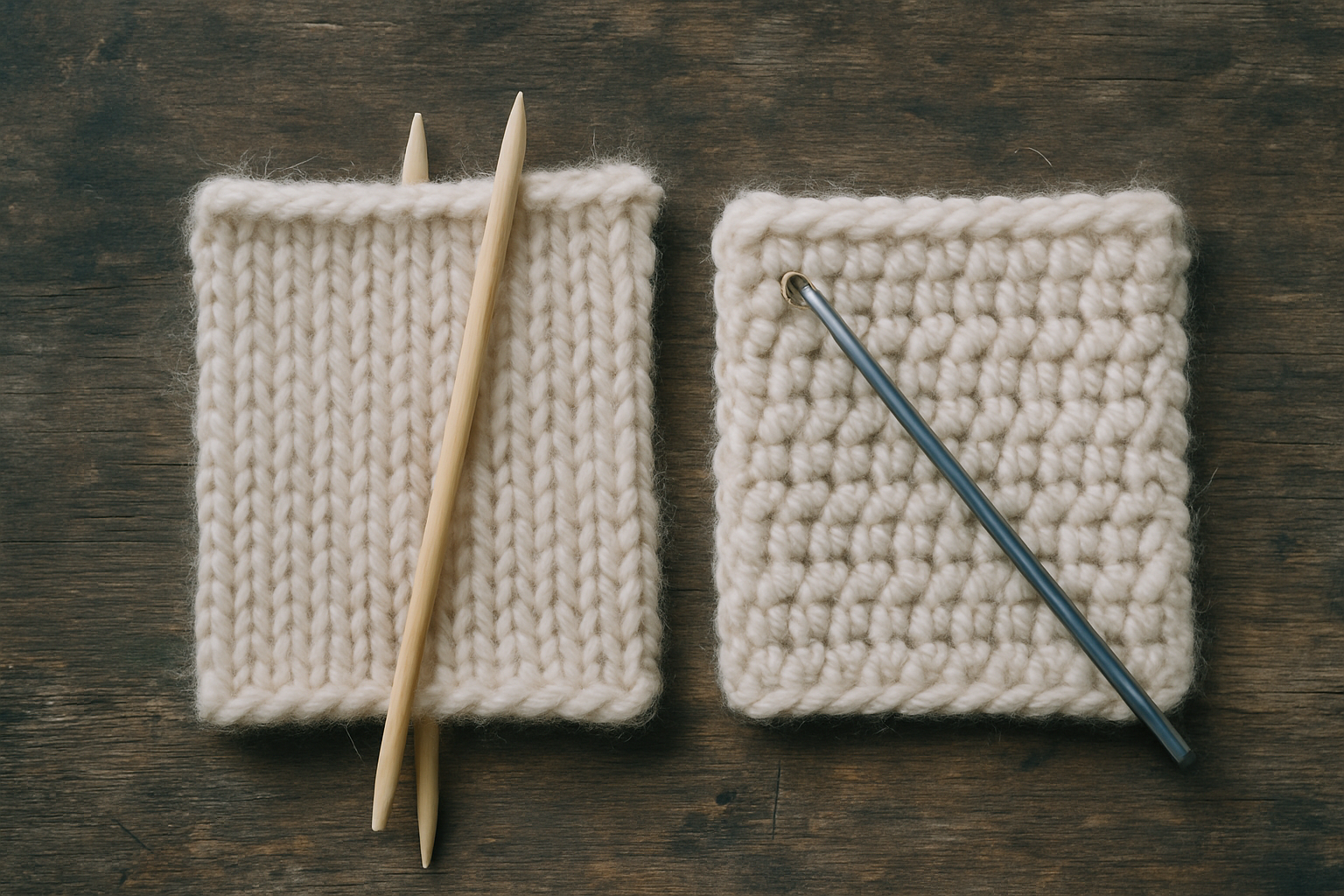
Knitting and crochet both turn a strand of yarn into fabric, and they share the whole yarn aisle. The split is in the loops. Knitting holds a full row of live loops on two needles and works them one at a time; crochet uses a single hook and finishes each stitch before starting the next, so only one loop is ever open. That one mechanical fact decides how the fabric stretches, how much yarn you buy, and how painful your mistakes are.
One live loop or a hundred
Look closely at a knitted sweater and you will see columns of small Vs. Each V is a loop pulled through the loop below it, and every loop leans on its neighbors for support. Until the piece is bound off, an entire row of those loops sits open on the needle. A sock might carry 60 live stitches at once; a sweater body can carry more than 200.
Crochet builds fabric from finished stitches. You wrap the yarn over a hook, pull it through, and the stitch is complete: a small, knot-like bundle that stands on its own. The surface shows rows of little posts and chains instead of Vs, and the fabric comes out noticeably thicker than a knit in the same yarn.
Designer Amy Gunderson tested this for Interweave with matching 20-stitch, 20-row swatches in one chunky yarn, on a 6 mm needle and a 6 mm hook. Stockinette covered 3.03 square inches per gram of yarn. Single crochet covered 1.89. Same yarn, same size tools, about 60 percent more yarn per square inch of crochet.
Source: Interweave, Yarn Usage for Knitting vs. Crochet: A Science Experiment (interweave.com).Which is easier to learn, knitting or crochet?
Crochet is easier to start, for one concrete reason: mistakes are cheap. Only one loop is ever live, so fixing an error means pulling the yarn back to the last good stitch and carrying on. In knitting, a loop that slips off the needle ladders down the fabric, and ripping back means picking up a full row of live stitches without twisting any of them.
Knitting answers with a smaller vocabulary. It has two foundation stitches, knit and purl, and nearly everything else is a combination of the two. Crochet's starter set is longer: chain, slip stitch, single crochet, half double, double, plus turning chains and the question of exactly where to insert the hook, which trips up more beginners than the stitches themselves do.
Neither craft takes long to enter. A wobbly first dishcloth is a weekend project either way. Pick by the fabric you want to end up with, not by the learning curve.
Does crochet use more yarn than knitting?
Yes. Plan on roughly 25 to 30 percent more yarn for a crochet project than for a knit one of the same size, and more still if the pattern leans on short, dense stitches. In the Interweave swatch test, measured per square inch of fabric:
- Double crochet used about 27 percent more yarn than stockinette.
- Half double crochet used about 36 percent more.
- Single crochet used about 60 percent more.
The reason is the anatomy of the stitch. A knit stitch is one loop pulled through another. A crochet stitch is a stack: yarn overs and pull-throughs bundled into a taller, wider unit that holds more yarn per inch of fabric.
You can see it printed on any ball band. A weight 4 (worsted) band quotes 16 to 20 knit stitches over 4 inches, but only 11 to 14 single crochet stitches across the same 4 inches, because each crochet stitch is wider and eats more of the strand. The Craft Yarn Council defines every weight category with both gauges side by side, and what is worsted weight yarn walks through reading the band.
One honest footnote: knit stitches vary too. Garter stitch, the bumpy fabric of most first scarves, used 46 percent more yarn than stockinette in the same test, which puts it close to crochet territory. The thrifty fabric is specifically stockinette, not knitting as a whole.
The extra yarn in crochet buys a thicker, warmer, sturdier fabric. For a blanket, that is a feature. For a drapey summer top, it is a cost.
Is crochet faster than knitting?
For blankets and other big flat pieces, crochet usually wins. A row of double crochet stands about twice as tall as a row of stockinette in the same yarn, so the fabric grows in bigger jumps, and there are no live stitches to shuffle along a needle. That is why crochet dominates blanket patterns and quick charity projects.
But hands matter more than crafts. A practiced knitter flicking through stockinette will outrun a beginner counting turning chains every row, and the reverse holds too. The fastest craft is the one your hands already know.
Knit stretches, crochet holds its shape
Most knitting vs crochet advice skips the fabric, and the fabric is the whole point. Knit fabric stretches in both directions because every loop can borrow slack from its neighbors. That is why sweaters, socks, hats, and anything with ribbing gets knit: the fabric hugs a body and springs back. It also drapes softly, which suits garments.
Crochet has more architecture. Each finished stitch acts like a small knot, so the fabric resists stretching and holds whatever shape you give it. That makes it the better tool for bags that keep their shape, stuffed toys (amigurumi) with firm walls, dense warm blankets, and lace edgings that keep their points after blocking.
Telling them apart takes one glance once you know the tell. Columns of flat Vs mean knit. Rows of taller posts, or a texture of little knots and shells, mean crochet.
A short history, and the machine test
Knitting is old. The earliest surviving knitted pieces are cotton socks from Egypt, worked in white and indigo somewhere around 1000 to 1400 AD, and their skilled two-color patterning says the craft was already mature. Crochet, for all its granny-square image, is the young one: the earliest known published crochet pattern appeared in the Dutch magazine Penelope in 1823.
Machines split the crafts for good. William Lee built the first knitting machine, the stocking frame, in 1589, and industrial descendants of it have made most of the world's knit fabric since, including nearly every T-shirt and sock sold today. Crochet has never been mechanized. Each stitch is completed through the previous one, with the hook's angle and tension adjusted as it forms, and no machine reproduces that sequence. So a mass-market garment labelled crochet was either made by hand, one stitch at a time, or it is a machine-knit imitation of the look.
Same yarn, same gauge math
The two crafts share materials completely. Any yarn works for both, the weight categories are identical, and every ball band prints a knit gauge and a crochet gauge together. Gauge itself works the same way in both crafts: stitches counted over 4 inches on a washed, blocked swatch.
If you land on knitting, gauge becomes your working number fast. Learn to count it cleanly in how to measure knitting gauge, then drop your numbers into the knitting calculator to turn a width in inches into stitches to cast on. And when a swatch misbehaves, gauge swatch mistakes lists the usual suspects.
The short version
Knitting: two needles, a row of live loops, stretchy fabric with drape, less yarn, the pick for garments. Crochet: one hook, one live loop, thick fabric with structure, about 25 to 60 percent more yarn depending on stitch, the pick for blankets, toys, and bags, and the more forgiving craft when you make mistakes. Same yarn either way. Try each for a weekend and let the fabric decide.
Sources
- Interweave, Yarn Usage for Knitting vs. Crochet: A Science Experiment (interweave.com).
- Craft Yarn Council, Standard Yarn Weight System (craftyarncouncil.com).
- Sheep and Stitch, The History of Knitting Part 1 (sheepandstitch.com).
- Littlejohn's Yarn, crochet history and the 1823 Penelope pattern (littlejohnsyarn.com).
Frequently asked questions
What is the main difference between knitting and crochet?
Knitting uses two needles and keeps a whole row of loops live at once; crochet uses one hook and completes each stitch before starting the next. Knit fabric is stretchy interlocked loops that drape well. Crochet fabric is built from knot-like stitches, so it is thicker and holds its shape.
Is knitting or crochet easier for beginners?
Crochet forgives mistakes better, since only one loop is live and ripping back is painless, while knitting has only two foundation stitches to learn, knit and purl. Most people find crochet quicker to start and knitting simpler to memorize. Both produce a usable dishcloth within a weekend of practice.
Does crochet use more yarn than knitting?
Yes, about 25 to 60 percent more for the same area, depending on the stitch. In Interweave's swatch test, double crochet used 27 percent more yarn than stockinette and single crochet used 60 percent more. Budget an extra skein or two when converting a knit project idea to crochet.
Can you use the same yarn for knitting and crochet?
Yes. Yarn has no craft allegiance: the Craft Yarn Council weight categories apply to both, and ball bands print a knit gauge and a crochet gauge side by side. A weight 4 band, for example, suggests US 7 to 9 needles and a 5.5 to 6.5 mm hook for the same strand.
Can crochet be made by machine?
No. Knitting was mechanized in 1589 with William Lee's stocking frame, and machines have made most knit fabric since. Crochet still requires hands, because each stitch forms through the previous one with constantly adjusted hook angle and tension. Store-bought crochet is either genuine handwork or a knit imitation.