How to join knitting in the round
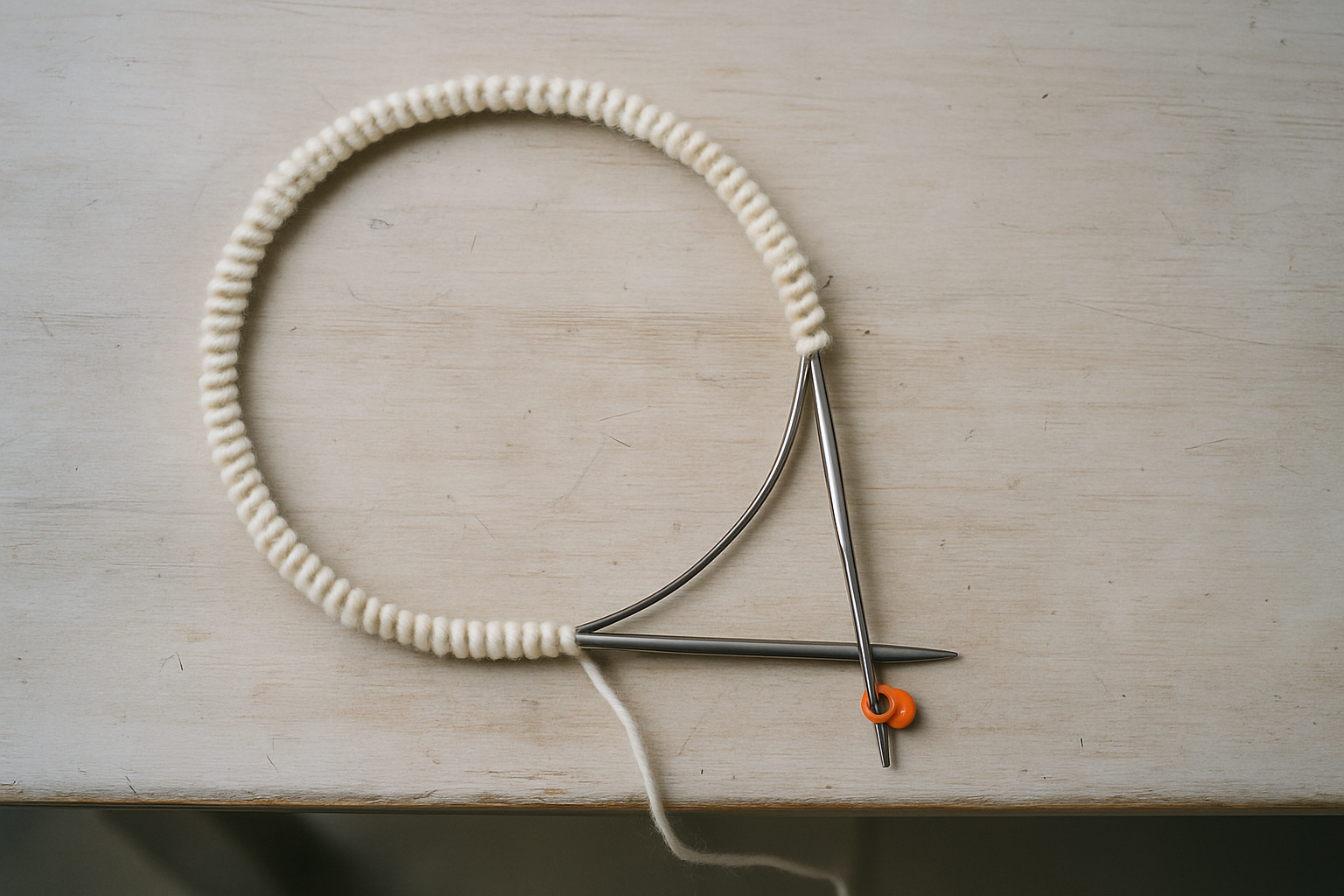
Joining in the round means closing your cast-on row into a circle so the fabric grows as a tube with no seam. The method that fails least: cast on one stitch more than the pattern asks for, lay the needle flat and confirm the cast-on edge spirals nowhere, then knit that extra stitch together with the first one. Your count comes back to what the pattern wants and the join pulls shut. Get the twist check wrong and there is no fixing it afterwards, so that check comes first.
Check the cast-on edge before you knit a single stitch
Set the needle on a table with the tips pointing right and the cable curving away from you. Look at the cast-on edge. Every bump should sit on the inside of the loop, facing the middle, forming one unbroken line the whole way around. If a section has flipped over the cable, straighten it now.
This is the step that costs people a project. A twist becomes permanent the moment you work round two over it. The fabric spirals like a Mobius strip, and the only repair is pulling the whole thing back to the cast-on. You cannot ladder it down and you cannot cut it out.
If twists have slipped past you before, knit the first three to five rows flat and join after that. A few rows of fabric make a twist obvious, and the tiny seam closes with mattress stitch at the end.
Source: Nimble Needles, how to join knitting in the round (nimble-needles.com).How do you join knitting in the round without a gap?
Cast on one extra stitch. Slip that last cast-on stitch onto the left needle, knit it together with the first cast-on stitch, and the round closes tight with your original count restored. Put a marker on the right needle after the k2tog so you can find the start of every round from then on.
Worked example. A worsted hat pattern calls for 96 stitches on a US 8 circular, the middle of the Craft Yarn Council's US 7 to 9 range for weight 4 yarn. Cast on 97. Line the stitches up so they all face the same way. Slip the last stitch you made onto the left needle, where it lands next to the very first stitch you cast on, and knit the two together. You are at 96, both ends of the cast-on row are locked to each other, and round one is under way.
A second method gets there without touching the count: cast on the number the pattern asks for, swap the first and last stitches so each crosses over the other, then knit. Some knitters find the swap neater, others find it fiddly with slippery yarn. Try both on a hat brim and keep the one your hands like.
Either way, tug the tail gently after a stitch or two. The join is the thinnest point in the cast-on row and a light pull takes up the slack. Do not yank it. A join hauled too tight reads as a pucker once the piece is blocked.
Pick the needle before you cast on
A circular needle can only be joined if the stitches reach all the way around the cable with slack left over. The rule is short: tip to tip, the needle has to be shorter than the finished circumference of the piece. Spread 96 hat stitches along a cable longer than the hat and the ends never meet, so there is nothing to join.
Elizabeth Smith's length guide lines up like this:
- 9 in for socks, sleeves worked in the round, and baby hats.
- 16 in for adult hats and cowls, which run about 18 to 22 in around.
- 24 in for kids' sweaters and small scarves.
- 32 in for adult sweater bodies, shawls, and blankets.
- 40 in for oversized sweaters and big blankets, 50 in around and up.
Under roughly 16 in of circumference the cable fights back, so knitters change tools. Double-pointed needles split the stitches across three or four needles while a spare one does the knitting. Magic loop does the same job on a single long cable, 32 or 40 in, by pulling a bight of cable out at the halfway point. Neither changes the join: same twist check, same extra stitch, same k2tog.
Round one feels terrible. Round four does not.
The first round on a small circumference is stiff and twisty, and the needles go everywhere. Nimble Needles describes it as juggling raw eggs, which is fair. After three or four rounds the fabric has enough body to hold its own shape and the work settles down.
What can follow you past round four is laddering: a column of stretched stitches climbing the fabric wherever one needle handed off to the next. The yarn has to travel further across that gap than it does between two stitches on the same needle, and the slack shows. Socks and sleeves show it worst, because the gaps land in the same place every round.
- Do not clamp down on the last stitch of a needle. Overcorrecting there leaves the following stitch loose and the ladder appears anyway.
- Snug up the first two stitches on a new needle and keep the two needle tips close to parallel while you work them.
- Move the boundary. Every few rounds, knit two or three stitches past the end of a needle so the handoff point shifts sideways and no single column takes the strain twice.
That last one is the fix worth learning first, since it moves the cause instead of fighting the tension.
Source: Jen Arnall-Culliford, Little lessons: avoiding ladders on double-pointed needles (actechniques.co.uk).Does knitting in the round change your gauge?
Yes, for most knitters, and the round gauge usually runs tighter. Stockinette worked flat alternates knit rows with purl rows. Worked in the round it is knit every round, no purling at all. Most people purl a shade looser than they knit, so taking the purls away pulls the fabric in. A flat swatch will lie to you about a tube.
Elizabeth Smith measured the same yarns both ways. A worsted-to-aran cotton blend gave 4 stitches per inch flat and 4.375 in the round, a gap of 0.375 stitches per inch. An aran-weight wool barely budged: 3.687 flat against 3.75 in the round. Fiber matters, and cotton punished the difference hardest.
Source: Elizabeth Smith Knits, Gauge Changer (in Seamless Knitting) (elizabethsmithknits.com).That cotton figure is not a rounding error. Take a sweater with a 40 in finished chest. Swatch flat at 4 stitches per inch and you cast on 160 stitches. Knit those same 160 stitches in the round at 4.375 and the tube comes out 36.6 in. You have lost 3.4 in of chest, which is a full size on most charts and sometimes two.
So swatch the way you will knit. If the body is worked in the round, work the swatch in the round on the same needle setup, and block it before you count anything. How to measure knitting gauge covers the counting, and gauge swatch mistakes covers the traps that produce a confident wrong number. Once you have the real figure, the knitting calculator turns a width in inches into stitches to cast on, and the knitting gauge converter rewrites a pattern's stitch counts to your gauge so the finished measurement holds. When yours and the pattern's still disagree, gauge doesn't match pattern walks through the three ways out.
Rows become rounds, and some stitch patterns flip
After the join you never turn the work. The right side faces you on every round and you always travel in the same direction. That quietly rewrites your stitch patterns.
- Stockinette gets easier. Knit every round and the purl side takes care of itself on the inside.
- Garter gets harder. Flat garter is knit every row; in the round it is knit one round, purl one round, all the way up.
- Charts written with wrong-side rows need converting before they work in the round, since those rows no longer exist.
Stripes pick up a visible step at the end of each round, because a round is a shallow spiral rather than a closed ring, so the first stitch of a new color sits one row higher than the last. Meg Swansen's fix, published in Meg Swansen's Knitting (Interweave, 1999): knit one full round in the new color, then at the start of the next round lift the right leg of the stitch one row below the first stitch, put it on the left needle, and knit it together with the stitch above it. The step vanishes, and the beginning of the round creeps one stitch to the left with every color change.
The short version
Cast on one extra stitch. Lay the needle flat and check that the cast-on edge runs unbroken with every bump facing in. Slip the extra stitch across, knit it together with the first, place your marker. Use a needle shorter than the piece is round, or reach for DPNs or magic loop under 16 in. Then swatch in the round before you trust any cast-on number, because for most hands the round gauge runs tighter than the flat one, and 0.375 stitches per inch is a whole sweater size.
Sources
- Nimble Needles, how to join knitting in the round (nimble-needles.com).
- Elizabeth Smith Knits, The Basics of Circular Needle Lengths and Gauge Changer (in Seamless Knitting) (elizabethsmithknits.com).
- Arnall-Culliford Techniques, Little lessons: avoiding ladders on double-pointed needles (actechniques.co.uk).
- Meg Swansen's Knitting (Interweave, 1999), via Interweave's jogless jog tutorial (interweave.com).
- Craft Yarn Council, Standard Yarn Weight System (craftyarncouncil.com).
Frequently asked questions
How do you join knitting in the round without a gap?
Cast on one stitch more than the pattern says. Slip that extra stitch onto the left needle so it sits beside the first stitch you cast on, then knit the two together. The count returns to the pattern's number and the join pulls closed. Place your marker after the k2tog and tug the tail gently to take up any leftover slack.
What happens if my knitting is twisted after joining in the round?
It cannot be repaired. Once you work a second round over a twisted cast-on, the fabric is a permanent spiral and the only fix is ripping back to the cast-on and starting over. Check before round two: lay the needle on a table and confirm every cast-on bump faces the inside of the loop in one unbroken line.
Do you turn your work when knitting in the round?
No. The right side faces you on every round and you keep going in the same direction, which is why stockinette in the round is knit every round with no purling. Garter reverses: it becomes one knit round, one purl round. Any chart with wrong-side rows needs rewriting before you can work it in the round.
What length circular needle do I need to join in the round?
Shorter than the finished circumference, tip to tip. Use 9 in for socks and baby hats, 16 in for adult hats around 18 to 22 in, 24 in for kids' sweaters, 32 in for adult sweater bodies, and 40 in for oversized knits. Below about 16 in of circumference, switch to double-pointed needles or magic loop.
Does gauge change when you knit in the round?
For most knitters, yes, and it comes out tighter, because every round is a knit stitch and purls tend to be the looser of the two. Elizabeth Smith measured one cotton blend at 4 stitches per inch flat and 4.375 in the round. Over a 40 in sweater that difference costs 3.4 in of chest, so swatch in the round when the piece is knit in the round.