How to weave in ends in knitting
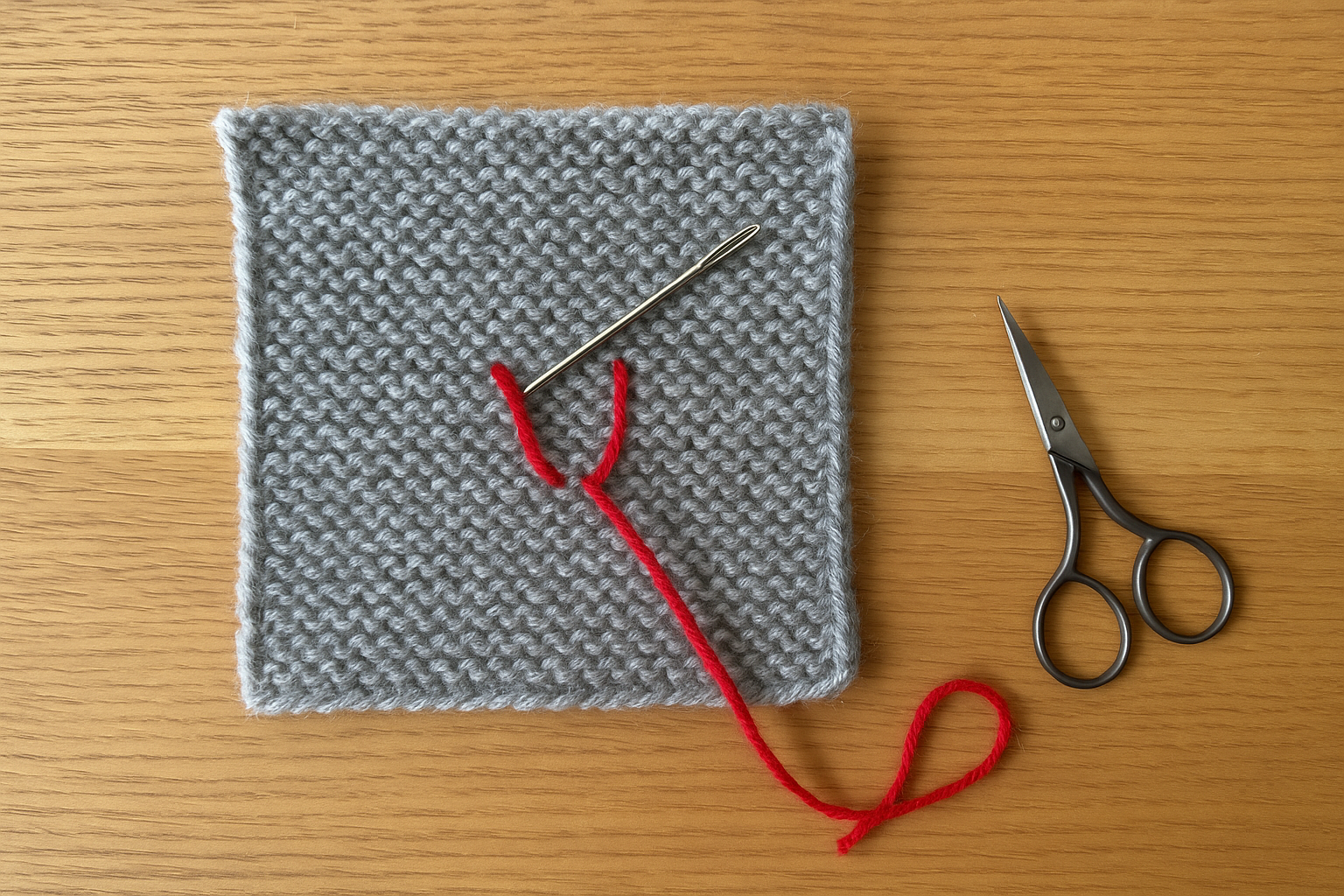
Thread the yarn tail onto a blunt tapestry needle, turn the work to the wrong side, and run the tail through the backs of 5 to 7 stitches. Then turn around and come back the other way on a parallel path. Stretch the fabric sideways, and trim what's left to about 1/4 to 1/2 in. That change of direction is what keeps the end from working loose. A tail that goes in one straight line can slide back out the way it came.
The numbers people argue about are small, and the sources agree on them. Kate Atherley, writing for Modern Daily Knitting, wants a tail of at least 4 in at every cast-on, bind-off and new ball, because anything shorter is a fight to thread. Cocoknits says 3 to 5 stitches of weaving holds a grippy wool, and a slippery yarn needs 5 to 7. Patty Lyons leaves 1/4 to 1/2 in after the last stitch instead of cutting flush.
How long should the tail be before you weave it in?
Leave 6 in (15 cm) when you have the choice, and never less than 4 in (10 cm). Six inches is enough to thread the needle, weave one way, turn, and weave back. Shorter tails still work if you thread the needle first and then slide it into the fabric, but you'll be pinching the end the whole time.
Longer isn't better past about 8 in. A long tail tangles while you weave, and you'll cut most of it off anyway. The exception is a cast-on or bind-off tail sitting next to a seam: leave 12 to 18 in and use it to sew that seam, so the tail disappears into the join and you weave nothing.
Stockinette: go diagonally through the purl bumps
Stockinette is the stitch most ends end up in, and its back is all purl bumps.
- Thread the tail on a blunt tapestry needle. A sharp needle is only for skimming, below.
- On the wrong side, slide the needle under the purl bumps on a diagonal, one bump per row, for 5 to 6 stitches. Nimble Needles uses the diagonal because it stretches with the fabric in both directions.
- Leave a little slack at the turn, then go back for another 5 to 6 stitches on a line next to the first one.
- Check the right side. If you can see a ridge or a pucker, you pulled too tight, so ease the fabric until it lies flat.
Keep the woven tail a bit looser than your knitting. Cocoknits makes this point for duplicate stitch, and it holds for every method: a tight tail makes a hard line the fabric can't stretch across, and on a fitted sweater that line shows.
Source: Cocoknits, How to Work in Ends with Duplicate Stitch (cocoknits.com).Duplicate stitch: the most invisible method
Duplicate stitch follows the path the yarn already takes through the fabric. On the wrong side, trace one row of purl bumps with the tail, going over and under exactly where the knitted strand goes, so the tail lies on top of the existing yarn. From the front, the stitches look twice as thick and nothing else changes.
Cocoknits adds a detail that makes it stronger: split the plies of the knitted yarn with each pass. Patty Lyons calls this skimming. It needs a sharp needle, and it grips far better than sliding under whole stitches because the tail is anchored inside the yarn, not behind it. Lyons uses it on aran weight and heavier, where a classic weave distorts the edge and the tail pokes through to the front.
Skip duplicate stitch on garter. Nimble Needles points out that it shows on garter's bumpy surface.
Garter stitch and ribbing
Garter
Garter has no right side to hide behind, so the tail goes where the fabric already has thickness. Push two ridges apart and run the needle through the legs of the knit stitches in the valley, sideways along the row, for 6 to 8 stitches. Come back through the same valley on the opposite legs. Modern Daily Knitting's version weaves under alternating ridges instead. That version holds well on a heavier garter.
Ribbing
Ribbing pulls in, and a tail woven across it stops it pulling in. So never weave across a rib. Weave up and down one knit column on the wrong side for 6 to 8 stitches, then back down the neighboring column. On a cuff or a hat brim this keeps the full stretch. If the end sits at a ribbed edge, you can run it along a rib or two and then work up and down the column lines until you run out of tail.
Slippery yarn: cotton, bamboo, silk and superwash
Smooth fibers don't grip, so a tail woven 5 stitches in a wool sweater will creep out of a cotton one after a few washes. Three changes fix it.
- Weave farther. Cocoknits's 5 to 7 stitches is the minimum on slick yarn, and more costs you nothing.
- Change direction twice, not once. A Z shape holds better than a U.
- Split the tail. Nimble Needles weaves 3 to 4 stitches, splits the plies of the tail into two halves, ties them in a single knot around a stitch on the wrong side, then weaves each half 3 to 4 stitches in a different direction.
What doesn't work on these yarns is the spit splice, the felted join where you wet two overlapping ends and rub them until the fibers mat together. It needs wool or another animal fiber that felts. Superwash wool is treated so it won't felt, so on superwash the join comes apart.
Where to join yarn so there are fewer ends to hide
The best end is one you never have to weave. Before you start a new ball, think about where the join lands.
- On a piece that will be seamed, join at the edge that becomes the seam. Both tails hide inside the seam allowance, and you can use one of them to sew it.
- On a flat piece that won't be seamed, like a scarf or blanket, join in the middle of a row, not at the edge. Atherley's reasoning: an end woven into a selvedge stretches it and shows.
- In the round, join where the eye doesn't go: the underarm on a sweater, the back of a hat.
- For stripes worked flat, carry the unused color up the side instead of cutting it. Twist it with the working yarn at the edge so it stays snug, and you only weave two ends for the whole run of stripes.
How to join knitting in the round covers the cast-on tail at the join, which you can use to close the small gap before you weave it in.
Should you weave in ends before or after blocking?
Either works, and the safe order is weave first, trim after. Purl Soho weaves ends before blocking but leaves at least 1 in hanging, then trims once the piece is dry. Blocking relaxes the fabric, and lace opens up the most, so an end trimmed short before blocking can pull back through when the stitches grow.
For lace, Nimble Needles goes further and does the weaving after blocking, once the openwork has its final size. Either way, the rule is the same: don't cut until the fabric is at the size it will be worn.
How to trim the tail so it doesn't pop out
Patty Lyons has a four-step clip that's worth copying exactly.
- Stretch the fabric to its full width. This sets the tail at the tension it'll have when worn, so it can't be pulled back in when the garment stretches later.
- Cut, leaving 1/4 to 1/2 in of tail.
- Fray that last bit with the tip of the scissors so the fibers fan out.
- Press the frayed end into the back of the fabric.
The frayed fibers catch on the stitches around them. A tail cut flush to the fabric has nothing to catch with, and it's the one that pokes through to the front after a wash. Cocoknits trims a little longer, about 1 in, and roughs it up the same way.
Plan the yarn for your ends
Ends use yarn, and a striped project uses a surprising amount. Every color change makes two ends: the tail you cut and the tail you start. At 15 cm per end, a sweater with 20 stripe changes is 40 ends and 6 m of yarn. A blanket with 80 changes is 160 ends and 24 m, which is about 26 yd.
That's small next to a 100 g skein of worsted at 170 to 240 yd, but it lands on your contrast colors, which are often the smallest amounts you bought. To count the joins before you start, turn each stripe height into rows with the knitting calculator: at 28 rows per 10 cm, a 5 cm stripe is 14 rows, so a 60 cm blanket in 5 cm stripes has 12 stripes and 11 color changes. What is worsted weight yarn has the yardage ranges for a skein, so you can see how much slack you have.
One more place ends matter: your swatch. If you plan to weave the ends of a garment on the wrong side, weave the swatch's too before you block and measure it. Loose tails curl the edges, and gauge swatch mistakes covers why a curling edge gives you a wrong count.
The short version
Leave at least 4 in, 6 if you can. Weave on the wrong side through 5 to 7 stitches, then turn and come back on a parallel line. Stockinette goes diagonal through the purl bumps. Garter goes along the valley between ridges. Ribbing goes up and down one knit column, never across. Slippery yarn gets more stitches, two turns, and a split tail. Join new yarn where a seam or an underarm will hide it. Stretch the fabric, then cut, leaving 1/4 to 1/2 in, and fray the end.
Sources
- Patty Lyons, Tuesday Tip: When Weaving In Ends, How to Clip the Yarn Tail, and Tuesday Tip: Weaving In Ends, Skimming (pattylyons.com).
- Kate Atherley, Techniques in Depth: How to Weave in Ends (moderndailyknitting.com).
- Cocoknits, How to Work in Ends with Duplicate Stitch (cocoknits.com).
- Nimble Needles, How to weave in ends in knitting (nimble-needles.com).
- Purl Soho, Weaving In Your Ends (purlsoho.com).
Frequently asked questions
How long should a yarn tail be to weave in?
At least 4 in (10 cm), and 6 in (15 cm) is easier to handle. That's enough to weave one way through 5 to 7 stitches, turn, and weave back. If the tail sits beside a seam, leave 12 to 18 in and sew the seam with it instead.
How many stitches do you weave an end through?
For wool and other grippy yarns, 3 to 5 stitches in each direction holds, according to Cocoknits. For cotton, bamboo, silk and superwash, go 5 to 7 or more, and change direction twice. The turn matters more than the distance, because it stops the tail sliding straight back out.
Do you weave in ends on the right side or the wrong side?
The wrong side. On stockinette that's the purl side, and you work the needle under the purl bumps so nothing shows from the front. Garter has no wrong side, so choose the side you like less and hide the tail in the valley between two ridges.
Should I weave in ends before or after blocking?
Weave before or after, but trim after. Blocking relaxes the fabric and can stretch lace a lot, so a short-trimmed end can pull back through. Purl Soho weaves first, leaves at least 1 in of tail, and cuts once the piece is dry.
Why do my woven ends keep poking out?
Usually they were cut flush or woven in a straight line. Weave in two directions, stretch the fabric to full width before cutting, and leave 1/4 to 1/2 in. Fray that stub with the scissor tips and press it in, as Patty Lyons does, so the fibers grip the stitches around them.